

Beyond the Drone: The Role of Ground Station Antennas and System-Level Optimization
Author:Xiamen Lineyi Electronics Co.,Ltd.
Click:
Time:2025-09-29 00:07:55
While much focus is placed on the drone itself, the communication link is a two-way street. The ground station antenna is arguably just as important as the antenna on the drone. You can have a perfectly designed drone antenna for agriculture, but if the signal from the ground station is weak or poorly directed, the overall system will fail.
This article shifts focus to the ground, exploring the types of ground station antennas and the principles of system-level optimization that ensure the entire RF chain—from the remote controller to the drone's receiver—is working in harmony to maximize agricultural drone range and reliability.
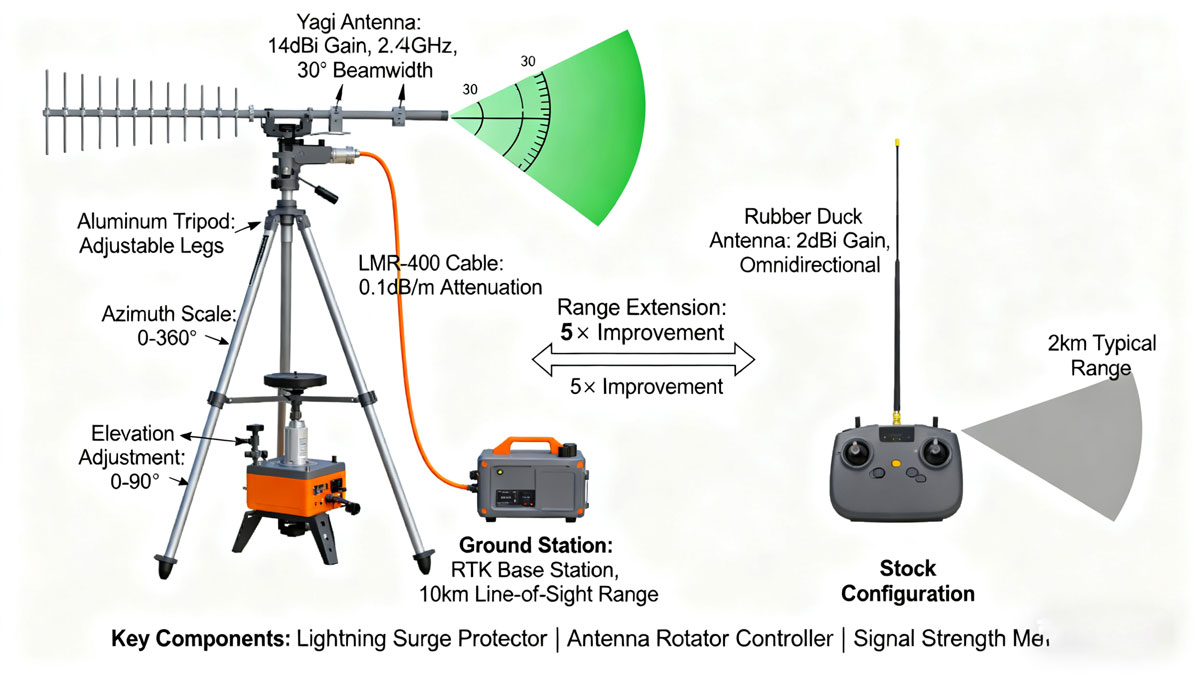
Types of Ground Station Antennas
- Omnidirectional Antennas: These are the stock antennas that come on most consumer-grade controllers. They radiate energy equally in all directions (like a sphere).
- Directional High-Gain Antennas: These are the tools of choice for serious agricultural operations aiming for long range.
- Polarization Matching: It is absolutely critical that the polarization of the ground station antenna matches that of the drone antenna. If the drone uses a Circularly Polarized (CP) antenna, the ground station must use a CP antenna of the same hand (usually Right-Hand Circular Polarization - RHCP). Using a linear antenna with a CP antenna can result in a significant signal loss (up to 20 dB).
System-Level Optimization: The Big Picture
Achieving maximum range and reliability is about optimizing the entire link budget—the accounting of all gains and losses from transmitter to receiver.
- The Link Budget Equation: This calculates the received signal strength.
Received Power (dBm) = Transmitted Power (dBm) + Transmitter Antenna Gain (dBi) - Path Loss (dB) + Receiver Antenna Gain (dBi)
To improve the link, you can: - Antenna Tracking Systems: For beyond-visual-line-of-sight (BVLOS) operations or very long-range links, manual antenna pointing is impractical. Automated tracking systems use the drone's GPS telemetry to physically steer a high-gain directional antenna (like a Yagi or dish) to keep it perfectly pointed at the drone at all times. This maintains the highest possible link quality.
- Redundancy: Professional systems often incorporate redundancy. This could be a dual-receiver setup with two separate antennas on the drone or even a complete backup communication link (e.g., a 4G/LTE modem) that can take over if the primary RF link fails.
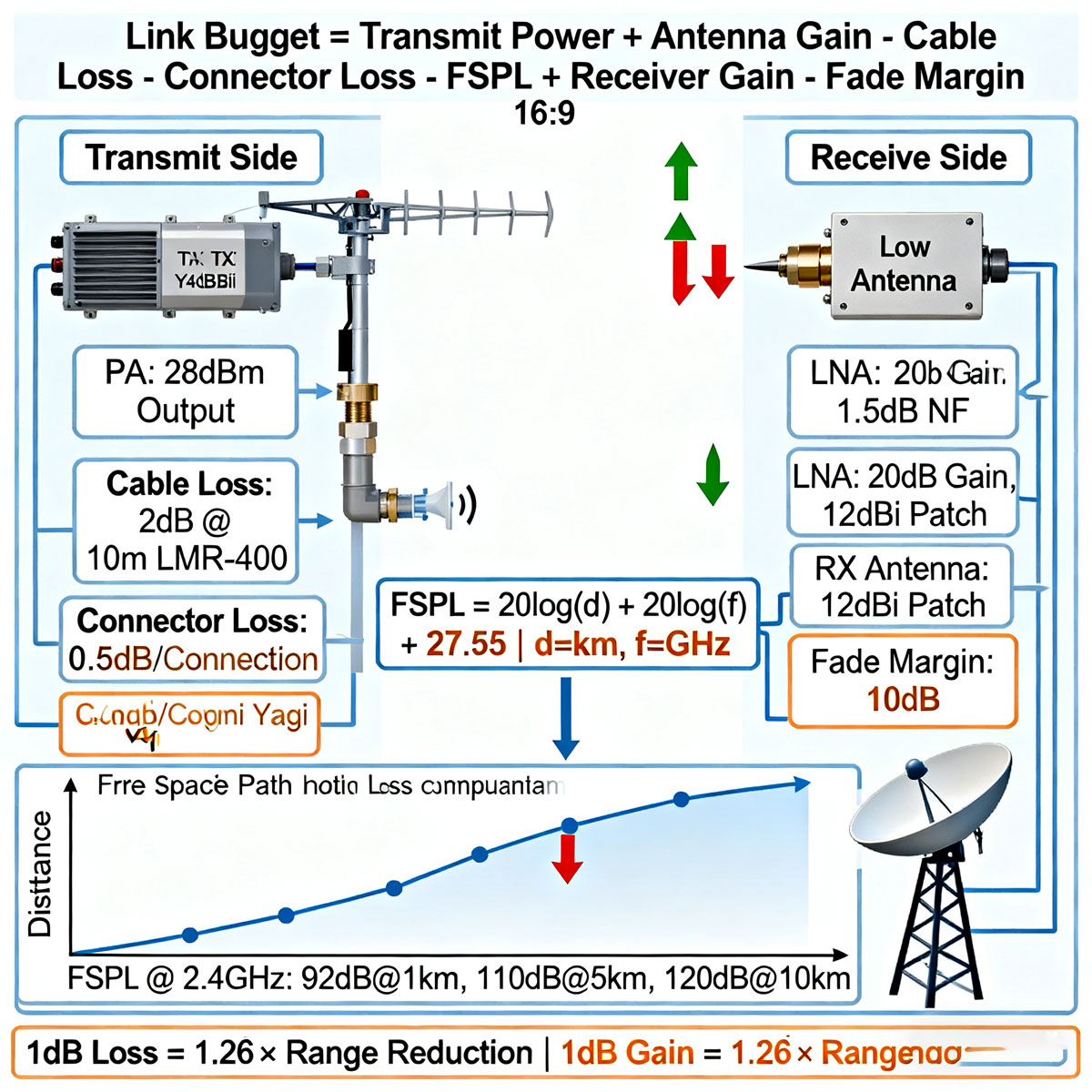
Optimizing the ground segment of the communication system is often the most cost-effective way to dramatically improve field performance. A well-designed ground station antenna setup is the unsung hero that enables reliable, long-range agricultural drone operations.
Boost your drone's range and reliability with Lineyi's high-gain ground station antennas. Our ruggedized Yagi and Panel antennas are designed for the field and come with the low-loss cables needed to preserve your signal.

点击右上角
分享给朋友吧







 Long by picture save/share
0
Copyright © Xiamen Lineyi Electronics Co., Ltd All rights reserved.
点击右上角
分享给朋友吧
