

Designing for Resilience: Key Anti-Interference Technologies for Drone Antennas
Author:Xiamen Lineyi Electronics Co.,Ltd.
Click:
Time:2025-09-20 16:34:38
The agricultural RF spectrum is a noisy, contested space. Beating interference requires more than just a good antenna radiator; it requires intelligent anti-interference antenna design at the system level. Modern solutions employ sophisticated signal processing techniques that work in tandem with the physical antenna to filter, avoid, or nullify interfering signals.
This article explores the key technologies that make modern agricultural drone control links resilient against the challenges outlined in Part 1.
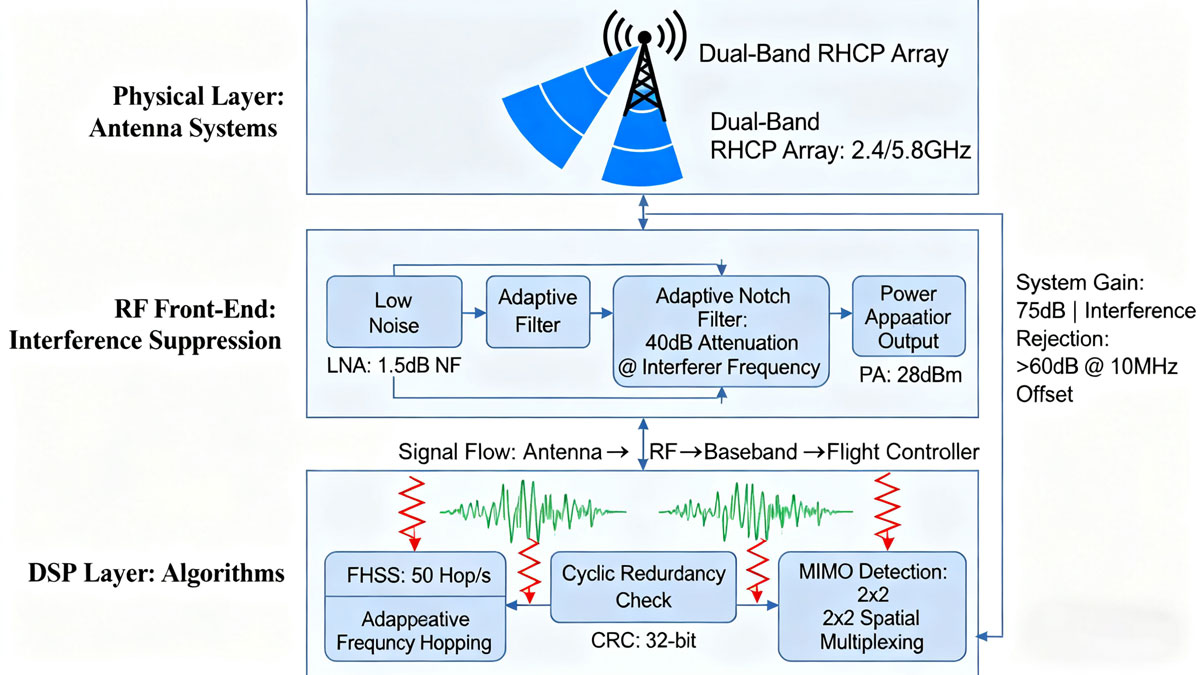
1. Spread Spectrum Techniques: Frequency Hopping (FHSS)
- How it works: Instead of transmitting on a single fixed frequency, the radio rapidly 'hops' between many different frequencies in a pseudo-random pattern known to both the transmitter and receiver.
- Why it works against interference: A narrowband interferencer (e.g., from a piece of farm equipment) will only block one or a few of these frequencies at a time. The system can maintain the link by using the other clear frequencies and use error correction to compensate for the brief lost data packets on the blocked channels. This is a very common and effective method for ensuring link robustness in license-free bands.
2. Adaptive Beamforming and Null Steering
This is a more advanced technique often associated with phased array antennas.
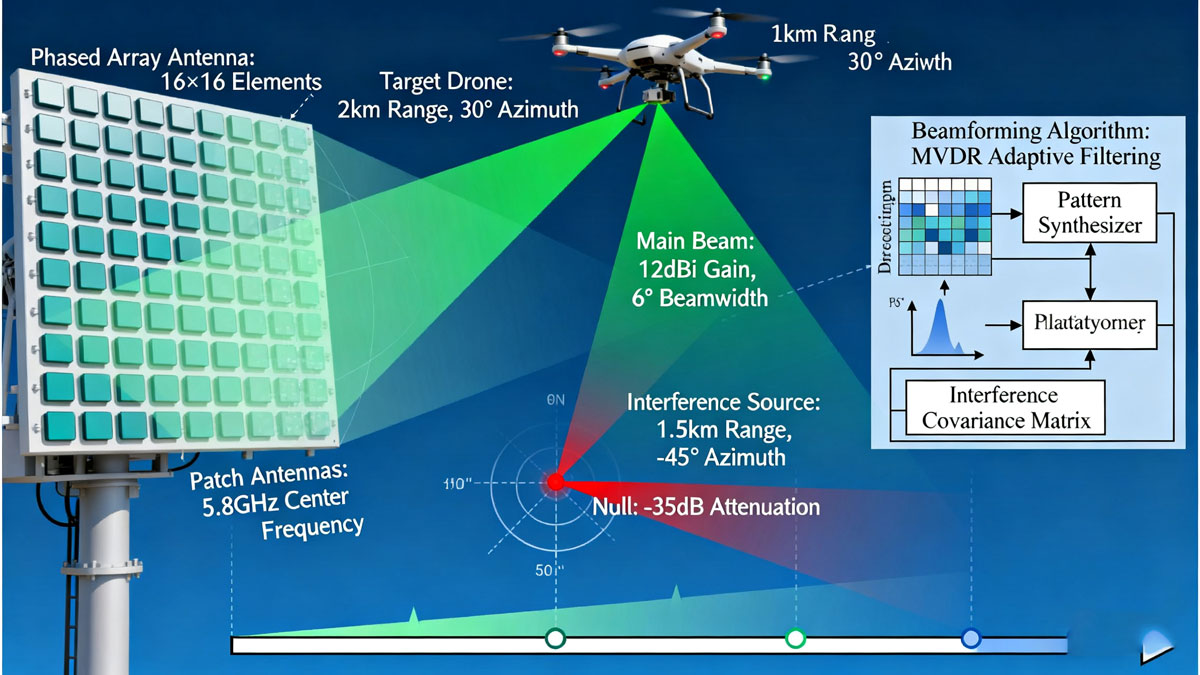
- How it works: A phased array uses multiple antenna elements. By precisely controlling the phase of the signal fed to each element, the system can electronically 'steer' a high-gain beam towards the desired target (the drone) without moving the antenna physically.
- The Anti-Interference Advantage: The same principle can be used in reverse. The system can analyze the direction from which an interference signal is arriving and then adapt its radiation pattern to create a 'null'—a point of very low sensitivity—in that exact direction. This effectively cancels out the interferer while maintaining the link to the drone. This requires significant processing power but is extremely effective against persistent, directional jamming or interference.
3. MIMO and Diversity Reception
As introduced in Article 2, MIMO is a powerful tool against interference, particularly multipath fading.
- Spatial Diversity: Using two or more physically separated antennas, the system can continuously choose the antenna with the strongest signal (a technique called 'switch diversity') or combine the signals from all antennas to create a more robust resultant signal. Since it's unlikely that both antennas will be in a signal null at the same time, diversity reception provides a huge boost to reliability.
- Polarization Diversity: Using antennas with different polarizations (e.g., one linear and one circular, or two orthogonal circular polarizations) can help capture signals that have been altered by reflections.
4. Filtering and Shielding
Sometimes, the simplest methods are foundational.
- Band-Pass Filters: These electronic components are placed in the RF chain to only allow signals within the desired frequency band (e.g., 902-928 MHz) to pass through. They aggressively reject strong out-of-band signals from nearby cellular towers, FM radio, or other services that could overload the receiver's front-end.
- Metallic Shielding: A recent study demonstrated an innovative anti-interference antenna design for GNSS systems on drones using metallic shielding9. The drone housed two GNSS antennas at different heights inside a metallic structure and one outside. An adaptive algorithm would select the antenna with the best signal-to-noise ratio, using the metallic shield to block low-elevation jamming signals coming from the ground. This same physical shielding principle can be applied to other critical drone communication links.
5. Smart Algorithms and AI
The future of anti-interference antenna design lies in intelligence. Systems are now incorporating algorithms that can:
- Classify Interference: Distinguish between different types of interference (narrowband vs. wideband, accidental vs. intentional) and apply the best mitigation strategy automatically.
- Predict Link Quality: Use data from past flights and real-time signal metrics to predict when a link might become unstable and proactively take action, such as commanding the drone to pause or return home before the link is lost completely.
Implementing these technologies requires a deep understanding of both RF physics and digital signal processing. For manufacturers of agricultural drones, partnering with antenna experts who understand these system-level challenges is key to delivering a product that operators can trust in the field.
Lineyi's engineering team specializes in integrating advanced anti-interference technologies into our antenna designs. Ask us about our solutions for FHSS-compliant antennas and MIMO array configurations.

点击右上角
分享给朋友吧







 Long by picture save/share
0
Copyright © Xiamen Lineyi Electronics Co., Ltd All rights reserved.
点击右上角
分享给朋友吧
