

Maximizing Signal Coverage: Antenna Types and Placement Strategies for Agricultural Drones
Author:Xiamen Lineyi Electronics Co.,Ltd.
Click:
Time:2025-09-20 15:57:20
In the battle for reliable connectivity over the farm, choosing the right antenna technology and placing it correctly on the drone are as important as the core anti-interference antenna design itself. You can have a brilliantly engineered antenna, but if it's mounted poorly or is the wrong type for the application, its performance will be severely compromised.
This article serves as a guide to the common antenna types used on agricultural drones and the critical principles of placement that ensure you achieve the maximum possible signal coverage and operational range.
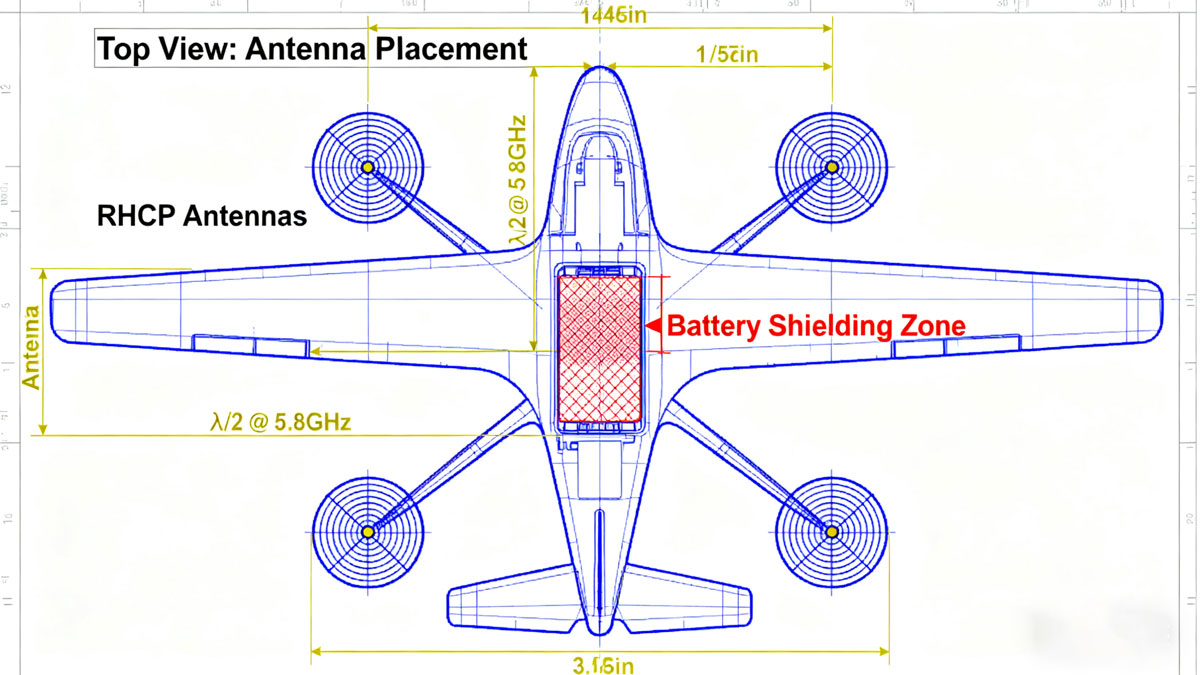
Antenna Types for Agricultural Drones
Circularly Polarized (CP) Antennas: As mentioned in Article 1, CP antennas are the gold standard for reliable drone communication.
How they work: They radiate energy in a corkscrew pattern, making them resistant to the signal degradation caused by the drone's rotation and multipath reflections.
Types: Common designs include Crossed Dipoles and Helical Antennas. Quadcopter-style drones often use small, omnidirectional CP antennas mounted on the legs.
Benefit: They provide a stable 'link budget' regardless of the drone's orientation, which is critical when the aircraft is maneuvering during a spraying pattern.
High-Gain Directional Antennas (Ground Station): While not on the drone itself, the ground station antenna is a vital part of the system. Parabolic grid antennas or panel antennas with high gain (e.g., 15 dBi or more) focus the RF energy into a narrow beam2. This significantly extends the range but requires the antenna to be pointed roughly at the drone. This is ideal for large, open-field operations where the drone is operating at a distance in a generally predictable area.
MIMO Antenna Arrays: Multiple-Input Multiple-Output (MIMO) technology uses multiple antennas at both the transmitter and receiver to exploit multipath propagation rather than suffer from it.
How it works: By using spatial diversity (antennas spaced apart) or pattern diversity (antennas with different radiation patterns), the system can transmit multiple data streams simultaneously, increasing throughput, or combine signals to improve reliability.
Application: A drone might have two or more antennas for its main control link. If one antenna's signal is blocked by the drone's body or experiences a null, the system can seamlessly switch to the other. This is a powerful form of anti-interference antenna design that is becoming standard on professional-grade agricultural drones.
Frequency-Specific Antennas: The choice of antenna is dictated by the operating frequency.
915 MHz Antennas: Larger due to the longer wavelength but offer excellent range and penetration. Often used for dedicated long-range telemetry/control links.
2.4 GHz Antennas: Smaller and more compact. Used for control and sometimes video. More susceptible to obstruction but very common.
5.8 GHz Antennas: Even smaller. Primarily used for analog video transmission due to the wide available bandwidth.
The Criticality of Antenna Placement
An antenna's performance is deeply affected by its immediate surroundings. Mounting it incorrectly can turn a high-performance component into an ineffective one.
The Ground Plane Effect: Many antenna designs, like whips or monopoles, require a 'ground plane' (a conductive surface) to function correctly. Mounting them away from the drone's carbon fiber or metal body can severely distort their radiation pattern and reduce efficiency.
Avoiding Shadowing: The biggest enemy of a drone antenna for agriculture is the drone itself. The battery, payload (spray tank, camera), and the frame can block RF signals. The key is to place antennas where they have a clear, unobstructed 'view' of the ground station.
Separation and Isolation: When multiple antennas are used (e.g., for MIMO or different frequency bands), they must be placed to minimize mutual coupling. This means spacing them apart (typically a minimum of a quarter-wavelength, but more is better) and orienting them differently if possible. Placing two identical antennas too close together can detune them and reduce system performance.
Polarization Alignment: For optimal performance, the polarization of the drone's antenna should match that of the ground station antenna. Since CP antennas are used, this is less of an issue than with linear antennas, but it's still a consideration.
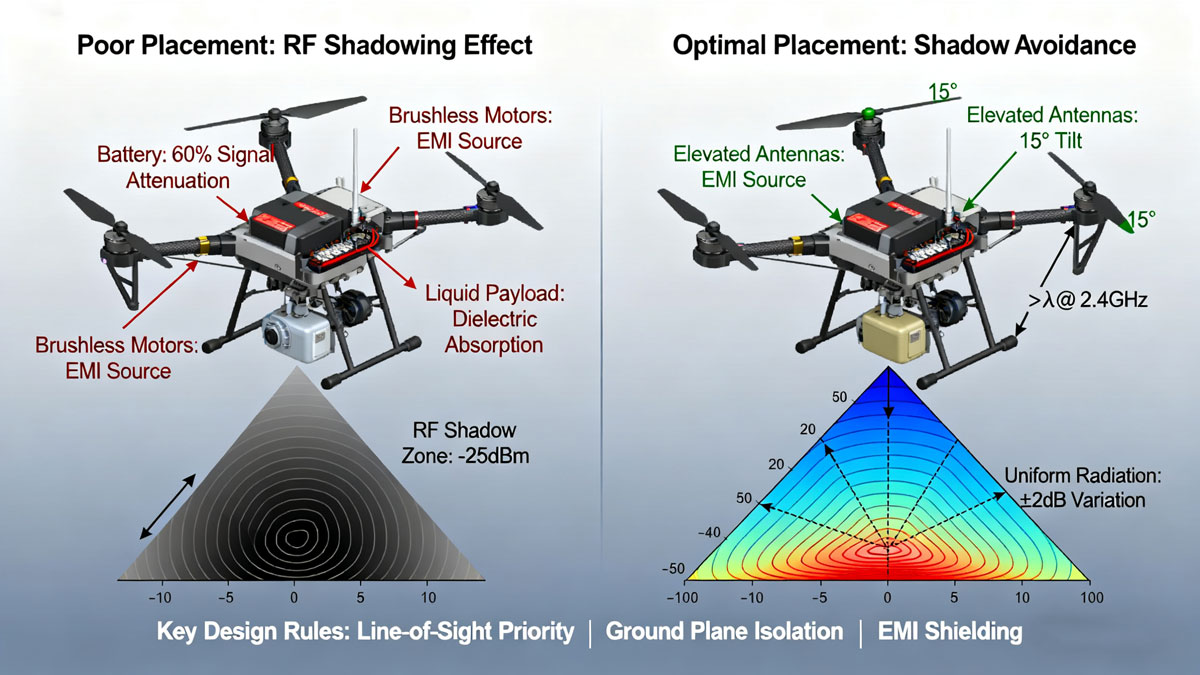
Common Successful Placement Strategies:
On the Landing Legs: A very common placement for omnidirectional CP antennas. It keeps them away from the main body and provides good all-around coverage.
Embedded in the Shell: Some advanced drones integrate antennas directly into the plastic shell, designed with specific materials and shapes to not detune the antenna. This offers excellent protection.
On a Mast: Some designs feature a short mast that extends above or below the drone, positioning the antenna completely clear of any obstructions. This is often seen for GPS/GNSS antennas to ensure a clear view of the sky9.
Selecting the right antenna type and applying these placement principles are foundational steps in building a robust communication system for any agricultural drone application, ensuring maximum signal coverage and minimizing the risk of dropouts.

点击右上角
分享给朋友吧







 Long by picture save/share
0
Copyright © Xiamen Lineyi Electronics Co., Ltd All rights reserved.
点击右上角
分享给朋友吧
