

How to Select a Smart Card Connector for High-Vibration Industrial Environments
Author:Xiamen Lineyi Electronics Co.,Ltd.
Click:
Time:2025-09-29 00:43:06
In the automated world of modern manufacturing, Industrial IoT (IIoT), and heavy machinery, reliable connectivity is the backbone of operational efficiency. Devices like programmable logic controllers (PLCs), industrial routers, and sensor gateways often rely on cellular connectivity for data transmission and remote management, which necessitates the use of SIM cards. However, the very environment that these devices operate in—filled with constant vibration, shock, and mechanical stress—is the nemesis of conventional electronic components. A standard smart card connector can quickly become a single point of failure, leading to unexpected network dropouts, data loss, and costly downtime.
Selecting the right industrial smart card connector is not a matter of chance; it's a critical engineering decision. This guide will walk you through the key factors to consider when choosing a vibration-resistant SIM holder that guarantees reliability in the most demanding conditions.
Understanding the Enemy: Vibration and Shock in Industrial Settings
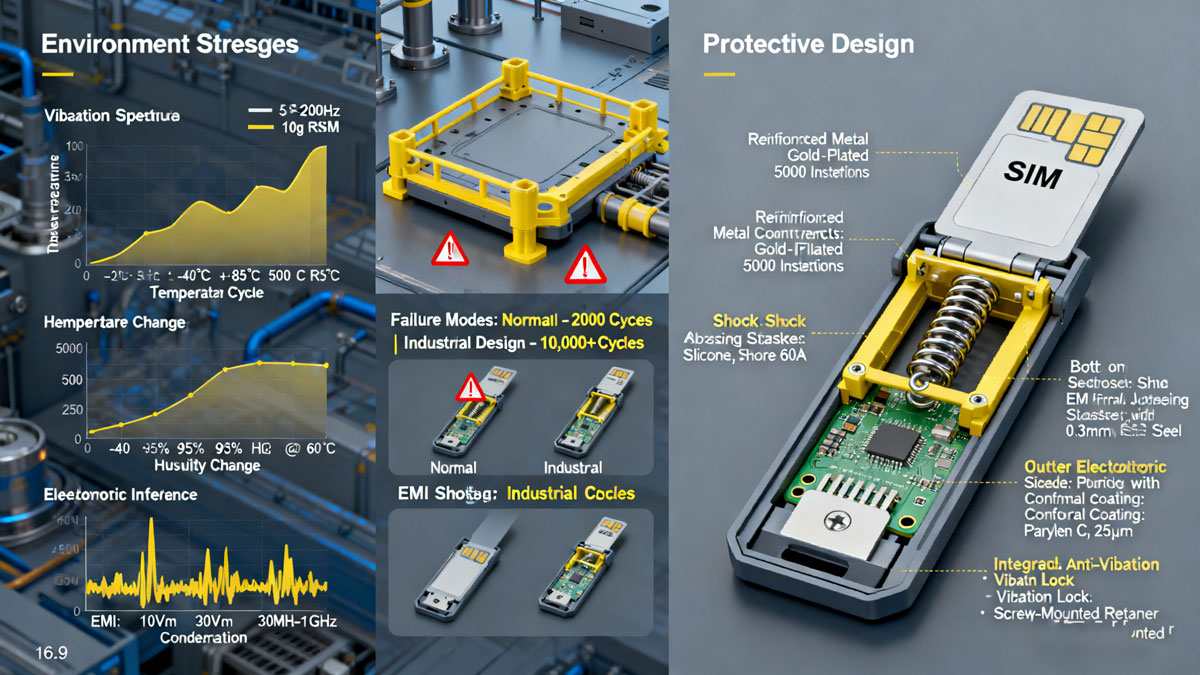
Before delving into solutions, it's crucial to understand the problem. Vibration in factories can come from a multitude of sources: rotating motors, conveyor systems, heavy-duty pumps, and the movement of large machinery. This creates persistent, low-amplitude oscillations. Shock, on the other hand, is a sudden, high-impact force, such as from a robotic arm halting abruptly or equipment being jarred.
These forces affect a SIM holder in several ways:
- Intermittent Connection: The primary issue is the SIM card momentarily losing electrical contact with the connector's terminals. This breaks the cellular link, requiring the device to re-register on the network, which disrupts data flow.
- Fretting Corrosion: Microscopic movements between the connector's contacts and the SIM card's pads can wear away the protective gold plating. This exposes the underlying base metal to air, leading to oxidation and increased electrical resistance, which can permanently degrade the connection.
- Mechanical Fatigue: The repeated stress can cause the plastic housing of the connector to crack or the delicate spring contacts to permanently deform, losing their normal force.
Key Selection Criteria for a Vibration-Resistant SIM Connector
To combat these challenges, your selection process must focus on the following engineering aspects:
1. The Locking Mechanism: Your First Line of Defense
This is the most critical feature. Forget standard friction-fit or simple push-push mechanisms; they are insufficient.
- Positive Locking Actuators: Look for connectors with a positive latching mechanism. This often involves a slider or lever that physically locks the SIM card into place. This mechanism provides an audible or tactile 'click' upon insertion, confirming that the card is secured and will not dislodge under vibration.
- Screw-Down Clamps: For extreme environments, some durable IC sockets feature a small screw or clamp that applies direct downward pressure on the SIM card, ensuring it remains immobile. This is the gold standard for SIM connector reliability in factory settings.
2. Contact Design and Material: Ensuring Electrical Integrity
The contacts inside the connector are responsible for maintaining a stable electrical connection.
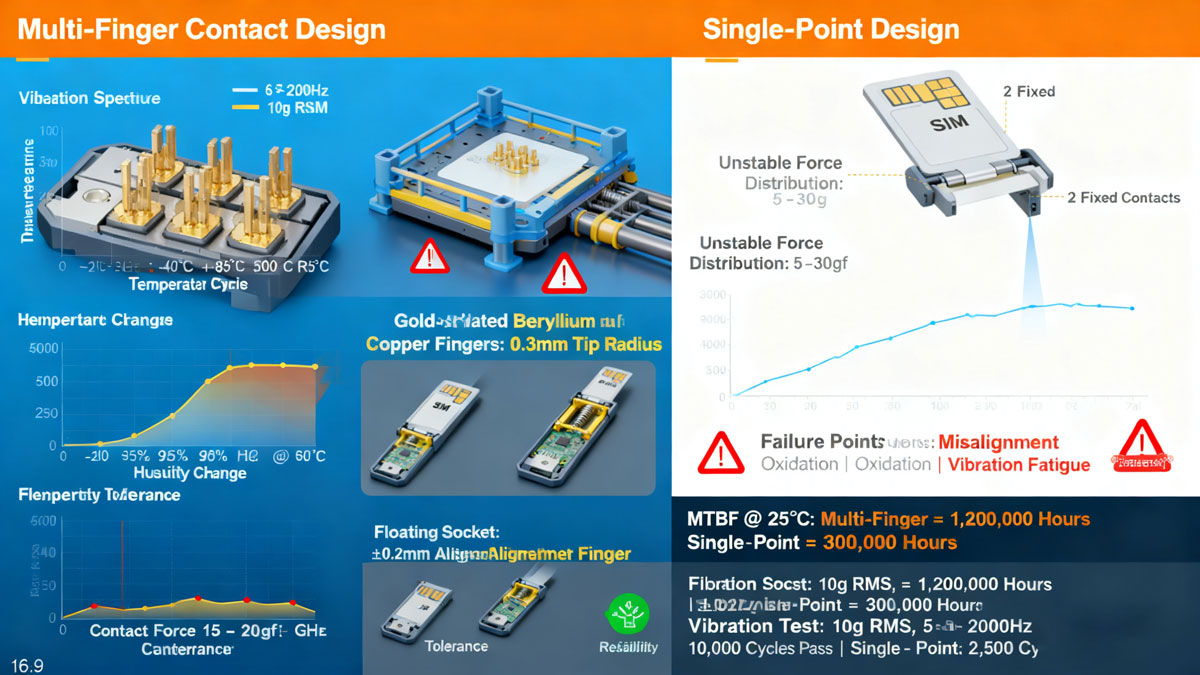
- Contact Normal Force: This refers to the pressure the spring contacts exert on the SIM card's pads. A higher normal force (specified in grams-force on a datasheet) is better for vibration resistance, as it requires more energy to break the contact. However, it must be balanced with easy insertion and removal.
- Multi-Finger Contact Design: Instead of a single point of contact, premium connectors use multiple spring fingers to contact each SIM pad. This redundancy ensures that even if one contact point is momentarily disturbed, others maintain the connection.
- High-Quality Plating: The contacts should have a thick gold plating (e.g., 0.76µm/30µ') over a nickel barrier. Gold offers excellent conductivity and superior corrosion resistance, which is vital for preventing fretting corrosion caused by micro-vibrations.
3. Housing Material and Construction: Building a Robust Foundation
The connector's body must be tough enough to withstand both impact and long-term stress.
- High-Temperature Thermoplastics: The housing should be made of glass-filled, high-temperature materials like LCP (Liquid Crystal Polymer) or PBT (Polybutylene Terephthalate). These materials offer high strength, rigidity, and resistance to creep under sustained mechanical load and temperature fluctuations common in industrial environments.
- Strain Relief Features: For soldered versions, check if the connector has robust solder tails or a design that minimizes stress transfer from the PCB to the solder joints. This prevents cracking on the board itself.
4. Validation Through Testing: Trust, But Verify
A reputable manufacturer will validate their product's resilience. Look for connectors that have been tested against recognized international standards.
- Vibration Testing: The connector should be tested per standards like IEC 60068-2-6 or MIL-STD-202G. The datasheet should specify the test profile (e.g., 10Hz to 500Hz, 10 G's).
- Shock Testing: Look for compliance with IEC 60068-2-27 or MIL-STD-202G for mechanical shock, which simulates sudden impacts.
- Mating Cycles: A high mating cycle rating (e.g., 10,000+ cycles) is an indirect indicator of a robust mechanical design and durable contact materials.
A Practical Checklist for Your Next Project
When sourcing a connector to prevent SIM card disconnection in machinery, use this checklist:
- Mechanism: Does it have a positive locking system (lever, slider, screw)?
- Contacts: Is the normal force high? Is it a multi-finger design with thick gold plating?
- Housing: Is it made of a high-strength, glass-filled thermoplastic?
- Testing: Does the datasheet show compliance with vibration and shock standards?
- Manufacturer Reputation: Does the supplier have a proven track record in industrial components?
Conclusion: Reliability is a Specification
In high-vibration industrial environments, SIM connector reliability cannot be an afterthought. By moving beyond commodity-level components and strategically selecting an industrial smart card connector based on its locking mechanism, contact design, housing material, and validated testing, you can eliminate a common but critical point of failure. This proactive approach ensures uninterrupted communication, protects your investment in industrial equipment, and maintains the seamless flow of data that smart factories rely on.
Struggling with connectivity issues in your industrial applications? Xiamen Lineyi specializes in designing and manufacturing high-reliability smart card connectors built to withstand the toughest environments. Our vibration-resistant SIM holders feature positive locking mechanisms and robust designs validated through rigorous testing. [Contact our engineering team today] to find the perfect solution for your project or to discuss custom ODM/ODM requirements.

点击右上角
分享给朋友吧







 Long by picture save/share
0
Copyright © Xiamen Lineyi Electronics Co., Ltd All rights reserved.
点击右上角
分享给朋友吧
