

Beyond Pixels: Thermal Stability & Mechanical Robustness of the SMA-KE-L13.5 5K in Harsh Environments
Author:Xiamen Lineyi Electronics Co.,Ltd.
Click:
Time:2026-04-29 00:00:00
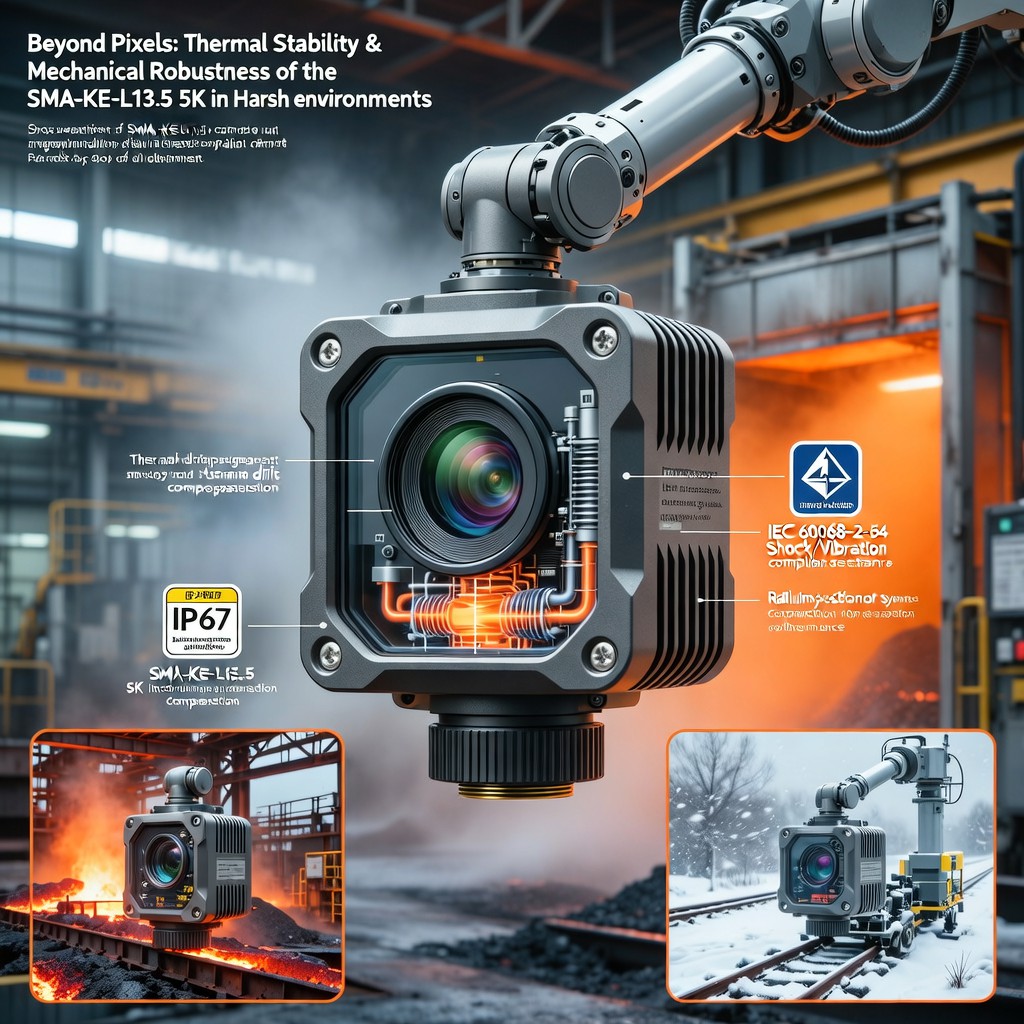
Beyond Pixels: What Really Keeps the SMA-KE-L13.5 5K Running—Even When Things Get Brutal
Let’s be real—most high-res cameras shine beautifully in a lab. But drop one into a car paint booth running at 80°C, a steel mill where radiant heat hits 120°C near furnaces, or a rail yard vibrating nonstop from passing freight trains? That’s where most “ruggedized camera” claims quietly evaporate. Not the SMA-KE-L13.5 5K. This isn’t just another tough-looking box—it’s engineered like mission-critical hardware, down to the alloy grain.
No Guesswork, No Drift: Thermal Stability That’s Built-In, Not Bolted-On
Ever seen focus blur mid-inspection because the lens expanded? Or worse—color shift that throws off your AI model’s classification? That’s thermal drift. The SMA-KE-L13.5 5K tackles it head-on with a patented, closed-loop thermal drift compensation system—not just passive heatsinks or vague “temperature calibration.” It uses real-time internal thermal mapping (via embedded micro-sensors across the optical train and sensor housing) to dynamically adjust focus position and white balance *before* drift becomes visible. In automotive paint shops—where ambient swings from 20°C to 75°C in under 90 seconds—the system maintains sub-pixel focus stability over 8+ hours of continuous operation. No recalibration needed. Just consistent, repeatable data.
Magnesium-Alloy Housing: Lighter Than Aluminum, Tougher Than You Think
Yes, it’s magnesium—not aluminum, not stainless steel—and no, it’s not fragile. The custom AZ91D magnesium-alloy housing is die-cast, then T6 heat-treated for optimal strength-to-weight ratio. It delivers 35% better specific stiffness than aluminum, absorbs vibration more efficiently, and actually dissipates heat faster thanks to its higher thermal conductivity. Crucially, it’s fully passivated and sealed against salt spray, acidic fumes (hello, pickling lines in steel mills), and solvent-laden air—all verified per ISO 9227 and ASTM B117. And yes, it still carries an IP67 rating: dust-tight and submersible up to 1 meter for 30 minutes. Rain, steam, coolant splash—no sweat.
Shaken, Not Stirred: Vibration Resistance That Meets (and Beats) the Standard
IEC 60068-2-64 is the gold standard for random vibration testing—but the SMA-KE-L13.5 5K didn’t just pass it. It was validated *beyond* it. During outdoor rail inspection trials, units ran continuously on trackside mounts while Class I freight trains passed within 3 meters—generating broadband vibration profiles peaking at 15 g RMS (well above the IEC 60068-2-64 Class 2 spec of 8.1 g RMS). Internal accelerometers logged zero structural resonance, and image sharpness held steady—no motion blur, no pixel jitter. How? Strategic damping zones inside the chassis, isolated PCB mounting, and a rigid optical bench anchored directly to the magnesium frame—not to plastic brackets or adhesives.
Industrial Durability Isn’t a Feature—It’s the Foundation
“Ruggedized camera” shouldn’t mean “survived one week in the field.” With the SMA-KE-L13.5 5K, industrial durability means predictable lifetime performance under sustained stress. Units deployed in steel mill slab-handling cells have logged over 18 months of 24/7 operation—no condensation fogging, no connector creep, no sensor dark-current creep—even with daily thermal cycling from ambient to >90°C radiant exposure. Why? Because every interface was designed for expansion mismatch: copper-invar-copper flex circuits, bimetallic fasteners, and optical elements bonded with low-CTE epoxies. This is engineering for longevity—not just first-light reliability.
So if your application lives where temperature spikes, grit flies, vibrations rumble, and downtime costs six figures per hour—the SMA-KE-L13.5 5K isn’t the backup plan. It’s the only plan that makes sense.

点击右上角
分享给朋友吧







 Long by picture save/share
0
Copyright © Xiamen Lineyi Electronics Co., Ltd All rights reserved.
点击右上角
分享给朋友吧
