

Understanding WiFi Antenna Gain and Coverage for Wireless Devices
Author:Xiamen Lineyi Electronics Co.,Ltd.
Click:
Time:2026-03-06 13:03:38
Wireless connectivity has become essential in modern communication systems, from consumer electronics to industrial IoT devices. While wireless modules and chipsets receive much attention during product development, the performance of a WiFi antenna often determines real-world signal strength and network stability.
One of the most frequently misunderstood parameters in antenna design is antenna gain. Many people assume that higher gain always means better wireless performance, but in reality, antenna gain affects coverage patterns and signal distribution.
At Xiamen Lineyi Electronics Co., Ltd., we provide antenna and RF connectivity solutions used in WiFi antenna, GPS antenna, Cellular antenna, and RF antenna systems. Understanding antenna gain helps engineers choose the right antenna configuration for their wireless devices.
1. What Is WiFi Antenna Gain?
Antenna gain describes how efficiently an antenna focuses radio energy in a particular direction compared with an ideal isotropic radiator.
Gain is typically measured in dBi (decibels relative to isotropic).
Higher gain does not increase transmitter power; instead, it redistributes signal energy into a more concentrated radiation pattern.
For example:
- 2 dBi antenna → wide coverage pattern
- 5 dBi antenna → moderate directional concentration
- 8 dBi antenna → narrow horizontal beam with extended range
Understanding this concept is essential when selecting the right antenna for a wireless device.
2. Radiation Pattern and Coverage Area
The radiation pattern of a WiFi antenna determines how signals spread through space.
Low-gain antennas
Low-gain antennas provide more uniform coverage in multiple directions. They are suitable for indoor environments where devices are located at different heights and angles.
High-gain antennas
High-gain antennas focus energy more strongly along the horizontal plane. This allows signals to travel further but reduces vertical coverage.
This means a high-gain antenna may actually perform worse in multi-floor environments if vertical coverage is needed.
3. Choosing the Right Gain for Different Applications
Different wireless devices require different antenna characteristics.
Indoor routers
Typical home routers use antennas between 3 dBi and 5 dBi, providing balanced coverage for multiple rooms.
Industrial gateways
Industrial equipment may use 5 dBi to 8 dBi antennas to improve long-distance connectivity in large facilities.
Embedded IoT devices
Compact devices often use internal PCB antennas with lower gain but optimized placement.
The goal is to match antenna characteristics with the expected wireless environment.
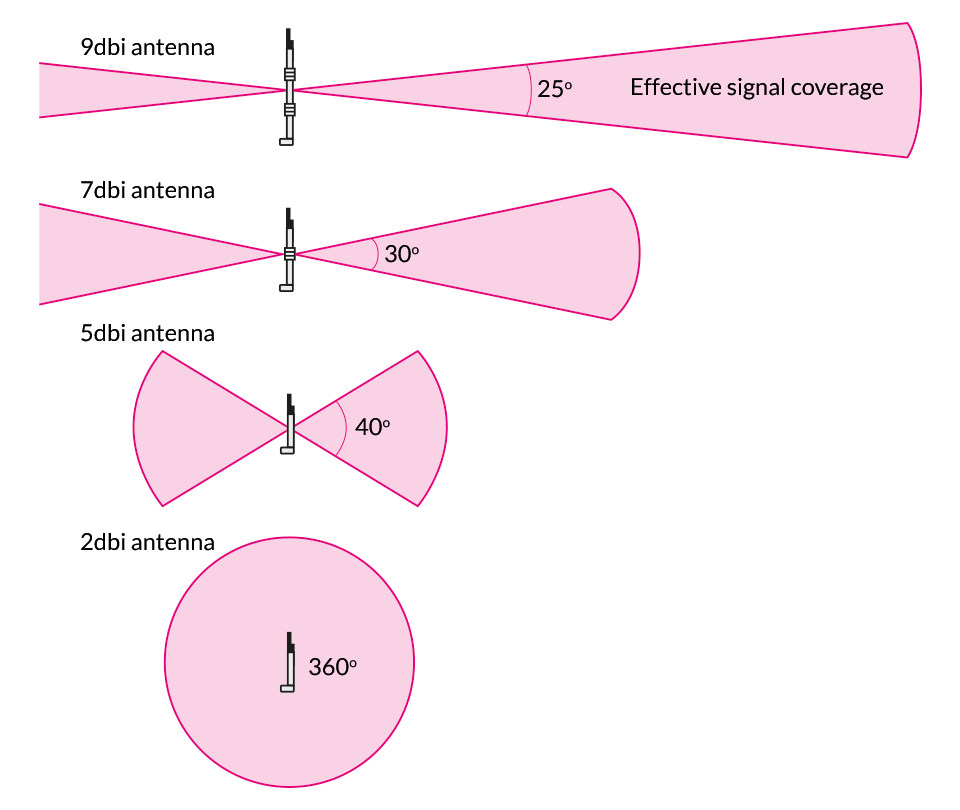
Different WiFi antenna gain levels produce different radiation patterns, influencing wireless coverage and signal strength distribution.
4. Internal vs External WiFi Antenna
When designing wireless devices, engineers must also decide whether to use internal or external antennas.
Internal antennas
Internal antennas are integrated into the device housing. They provide a cleaner product design and protect the antenna structure.
However, internal antennas require careful PCB layout and enclosure design to maintain performance.
External antennas
External antennas usually connect through RF connectors such as SMA or IPEX connectors. They allow flexible positioning and can improve signal strength in challenging environments.
External WiFi antennas are commonly used in industrial routers, access points, and IoT gateways.
5. Interference and Multi-Antenna Systems
Modern wireless devices often include several radio systems simultaneously.
A typical device may include:
- WiFi antenna for local communication
- Cellular antenna for wide-area connectivity
- GPS antenna for positioning
- Additional RF antenna for IoT communication
When multiple antennas operate within the same device, proper isolation and spacing are necessary to prevent signal interference.
Maintaining adequate separation and impedance matching ensures stable wireless performance.

WiFi antenna systems may use internal PCB antennas or external antennas connected through RF connectors such as SMA or IPEX.
6. Connector and Cable Considerations
The performance of a WiFi antenna system also depends on the RF connector and cable assembly.
Poor cable quality or incorrect connector matching may introduce signal loss even when the antenna itself performs well.
Common connector types include:
- SMA connectors
- IPEX connectors
- MMCX connectors
Ensuring consistent 50-ohm impedance across the entire RF path helps maintain signal integrity and reduces reflection loss.
A WiFi antenna plays a critical role in determining wireless signal coverage and network reliability. By understanding antenna gain, radiation patterns, and installation conditions, engineers can design wireless systems that deliver stable and efficient performance.
Xiamen Lineyi Electronics Co., Ltd. provides professional antenna and RF connectivity solutions supporting WiFi antenna, GPS antenna, Cellular antenna, and RF antenna applications for industrial and commercial wireless communication systems.

点击右上角
分享给朋友吧







 Long by picture save/share
0
Copyright © Xiamen Lineyi Electronics Co., Ltd All rights reserved.
点击右上角
分享给朋友吧
