

Understanding 433 MHz RF Antenna Applications in IoT Devices
Author:Xiamen Lineyi Electronics Co.,Ltd.
Click:
Time:2026-03-11 16:39:27
Wireless communication technologies continue to expand across industrial automation, smart agriculture, remote monitoring, and IoT sensor networks. While high-speed wireless systems such as WiFi antenna and Cellular antenna solutions dominate consumer devices, many industrial applications rely on lower-frequency RF antenna systems for longer range and greater reliability.
One of the most widely used frequencies in industrial wireless communication is 433 MHz. A properly designed 433 MHz RF antenna can provide stable connectivity for low-power devices over long distances, making it ideal for sensor networks and embedded communication systems.
At Xiamen Lineyi Electronics Co., Ltd., we provide antenna and RF connectivity solutions used in various wireless applications, including GPS antenna, WiFi antenna, Cellular antenna, and other RF antenna technologies. This article explores how 433 MHz antenna systems work and how to choose the right solution for IoT devices.
1. Why 433 MHz Is Popular in IoT Communication
Compared with higher-frequency wireless technologies, sub-GHz communication offers several advantages.
Longer transmission range
Lower frequency signals experience less attenuation when traveling through obstacles such as walls, vegetation, and industrial structures.
Lower power consumption
IoT devices often rely on battery operation. 433 MHz communication allows efficient long-range transmission while maintaining low energy consumption.
Reliable signal penetration
In complex environments such as factories, warehouses, and farms, lower-frequency RF antenna systems provide more stable connectivity than higher-frequency wireless solutions.
Because of these advantages, 433 MHz communication is widely used in:
- remote sensor networks
- smart agriculture systems
- industrial monitoring equipment
- wireless alarm systems
- environmental data logging devices
2. Types of 433 MHz RF Antenna
Several antenna designs are commonly used for 433 MHz communication systems.
Helical antenna
Helical antennas are compact and widely used in embedded modules. They are suitable for devices where internal antenna placement is required.
Whip antenna
External whip antennas provide higher gain and improved signal coverage. They are commonly used in outdoor equipment or long-distance communication systems.
PCB antenna
Some IoT devices integrate RF antenna structures directly onto the PCB, reducing cost and simplifying assembly.
Each type offers different trade-offs between size, gain, and installation flexibility.
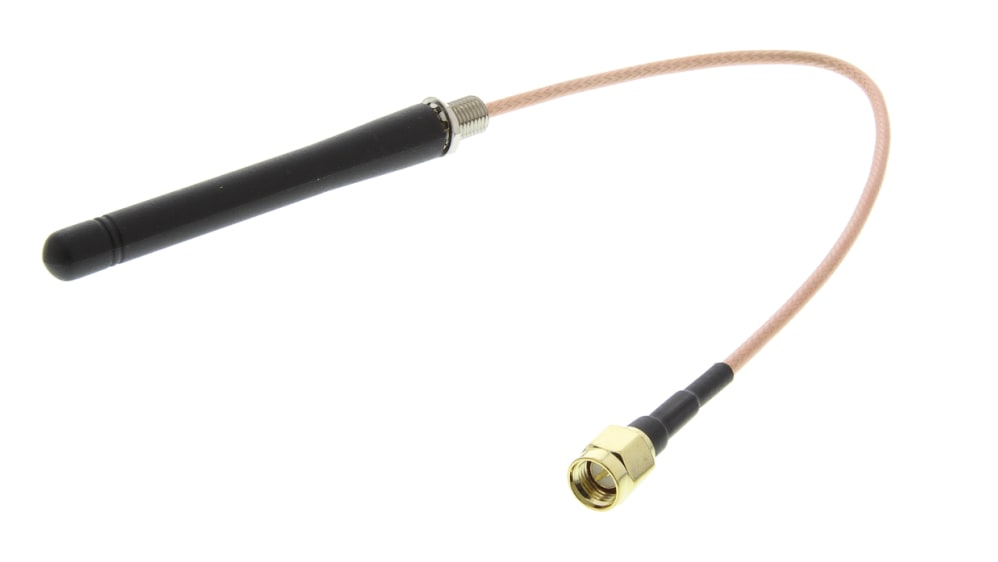
Common antenna designs used for 433 MHz wireless communication including helical antennas, whip antennas, and PCB antenna structures.
3. RF Connector and Cable Considerations
Antenna performance is not determined solely by the antenna element itself. The RF connector and cable assembly also play a crucial role in maintaining signal quality.
For 433 MHz antenna systems, common RF connectors include:
- SMA connectors
- MMCX connectors
- IPEX (U.FL) connectors
Maintaining 50-ohm impedance matching between the antenna, cable, and RF module helps minimize signal reflection and insertion loss.
Proper connector selection also improves long-term reliability, especially in industrial environments where vibration or temperature variation may occur.
4. Antenna Placement and Installation
Correct antenna placement is essential for optimal wireless performance.
Avoid metal obstruction
Metal surfaces can detune the RF antenna and reduce radiation efficiency.
Maintain antenna orientation
Vertical orientation often provides the most consistent radiation pattern for whip antennas.
Ensure adequate ground plane
For PCB-based antenna designs, the ground plane significantly influences signal performance.
Consider environmental exposure
Outdoor devices should use weather-resistant antenna housings and secure connector connections.
Proper installation ensures stable communication even in challenging environments.
5. Integration with Other Wireless Systems
Modern IoT devices frequently combine multiple wireless technologies. A typical device may include:
- 433 MHz RF antenna for long-range sensor communication
- WiFi antenna for local network access
- Cellular antenna for cloud connectivity
- GPS antenna for positioning and tracking
When multiple antennas are installed in the same device, proper spacing and shielding are necessary to prevent interference and maintain signal integrity.
Engineering teams often evaluate antenna layout early in the design process to optimize wireless performance.
6. Future Trends of Sub-GHz Wireless Communication
As IoT networks continue to expand, sub-GHz technologies remain highly relevant due to their efficiency and coverage advantages.
Emerging trends include:
- smart agriculture monitoring networks
- industrial IoT sensor grids
- remote infrastructure monitoring
- smart city environmental sensing
These applications require reliable RF antenna and connector solutions capable of supporting long-term field deployment.
Although high-frequency wireless technologies receive significant attention, sub-GHz communication such as 433 MHz RF antenna systems remains essential for long-range, low-power IoT networks.
By selecting the correct antenna design, ensuring proper RF connector integration, and optimizing installation conditions, manufacturers can significantly improve wireless reliability.
Xiamen Lineyi Electronics Co., Ltd. provides professional antenna and RF connectivity solutions supporting WiFi antenna, GPS antenna, Cellular antenna, and RF antenna applications across industrial wireless communication markets.

点击右上角
分享给朋友吧







 Long by picture save/share
0
Copyright © Xiamen Lineyi Electronics Co., Ltd All rights reserved.
点击右上角
分享给朋友吧
