

5G vs WiFi 6: Choosing the Right Technology for Speed, Latency, and Use Case
Author:Xiamen Lineyi Electronics Co.,Ltd.
Click:
Time:2025-12-17 15:46:09
Now that we've established the fundamental difference between 5g and wifi at a technical level, the next logical question is: how do they compare where it matters most—in real-world performance and application? Choosing between a 5g cellular technology link and a modern 5g wifi network (WiFi 6) isn't about which is universally 'better,' but about which is optimal for your specific scenario. This article provides a head-to-head comparison across key performance metrics and maps them to practical use cases.

Head-to-Head: Performance Metrics Compared
- Peak Speed & Capacity: A Tie on Paper, Different in Practice
- Latency: The Race for Responsiveness
- Range & Mobility: The Clear Divider
- Control & Security Models
Application Scenarios: Matching Technology to Task
Understanding the difference between 5g and wifi becomes crystal clear when applied to real-world uses.
Choose 5G Cellular When:
- Mobile Connectivity: For smartphones, tablets, and connected vehicles anywhere.
- Fixed Wireless Access (FWA): Providing home internet in areas without fiber/cable, using a 5G router.
- Massive IoT Deployments: Connecting thousands of sensors across a city (smart meters, asset trackers).
- Mission-Critical Mobility: Public safety, field services, and logistics requiring always-on, wide-area connectivity.
Choose WiFi 6/6E When:
- High-Density Indoor Environments: Offices, apartments, stadiums where many devices connect in a small area. WiFi 6’s OFDMA and MU-MIMO excel here.
- Local Network Performance: High-speed file transfers between devices, LAN gaming, or video editing on a local NAS.
- Smart Homes: Connecting and managing dozens of IoT devices (lights, speakers, cameras) reliably within your home.
- Controlled Enterprise Spaces: Factories, campuses, or hospitals where you own the infrastructure and need predictable, high-bandwidth connectivity.
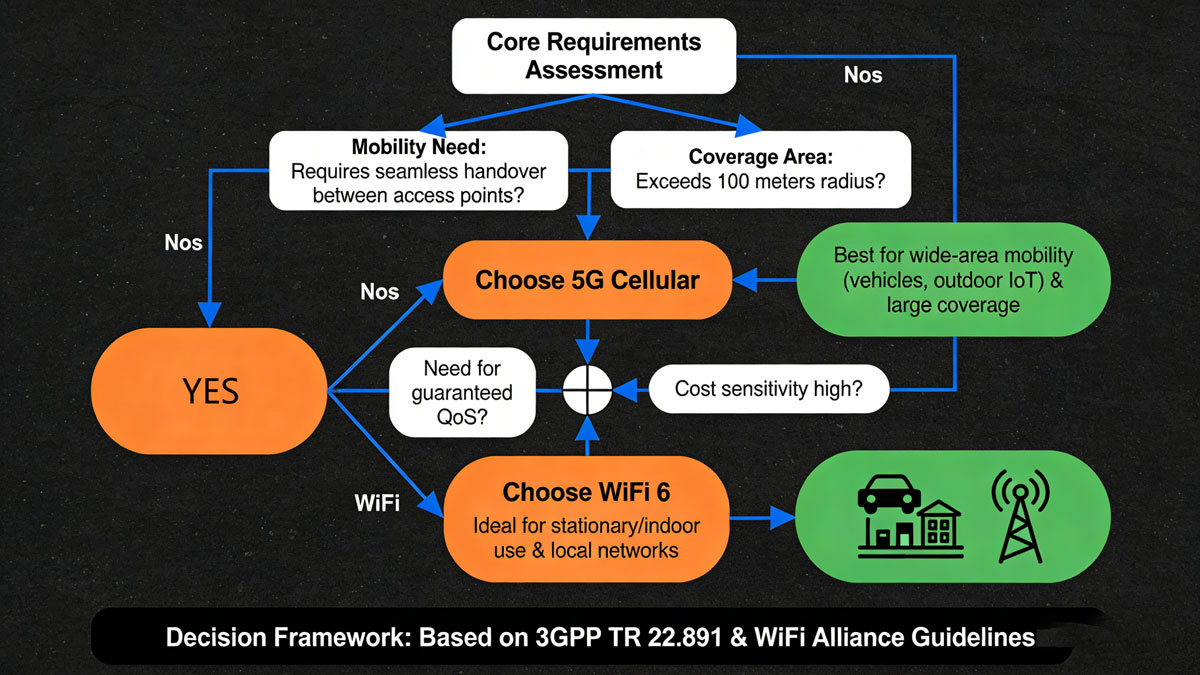 A simple decision flowchart to guide the initial choice between 5G Cellular and WiFi 6 based on core mobility and coverage needs.
Synergy, Not Just Rivalry
The most powerful setups use both technologies synergistically. A typical smartphone uses 5g cellular technology outdoors and automatically switches to the 5g wifi network at home or work for better speed, battery life, and to offload data from the cellular network. This seamless cooperation is the true future of connectivity.
Conclusion
Asking is 5g wifi the same as 5g cellular reveals a common misunderstanding. 5G Cellular is a mobile, wide-area service for ubiquitous coverage. WiFi 6 is a fixed, local-area technology for high-performance, controlled environments. The choice isn’t either/or, but about selecting the right tool—or combination of tools—for the job at hand.
Optimize your devices for their intended network. Xiamen Lineyi’s expertise spans both domains, offering antennas fine-tuned for the specific frequencies and performance profiles of 5G cellular and WiFi 6/6E standards. [Browse our antenna solutions] to enhance your product's connectivity.

点击右上角
分享给朋友吧







 Long by picture save/share
0
Copyright © Xiamen Lineyi Electronics Co., Ltd All rights reserved.
点击右上角
分享给朋友吧
