The successful implementation of satellite communication SSPAs requires careful consideration of dramatically different operational environments—from the controlled conditions of terrestrial ground stations to the harsh rigors of space. Understanding these implementation challenges is crucial for selecting the right VSAT power amplifier for ground applications or specifying space qualified SSPA for orbital payloads.
This implementation guide explores the practical considerations for deploying SSPAs across the complete satellite communication ecosystem.

VSAT Power Amplifier Solutions: Optimizing Ground Segment Performance
Very Small Aperture Terminal (VSAT) networks represent the most widespread application of satellite communication SSPAs, with implementations ranging from enterprise networks to emergency communications.
VSAT Power Amplifier Classes and Applications:
Commercial Enterprise VSAT (1-8W):
- Office connectivity and retail point-of-sale systems
- Compact, fan-cooled designs for indoor installation
- Cost-optimized while maintaining carrier-grade reliability
Enterprise and Government VSAT (10-40W):
- Corporate networks and emergency response systems
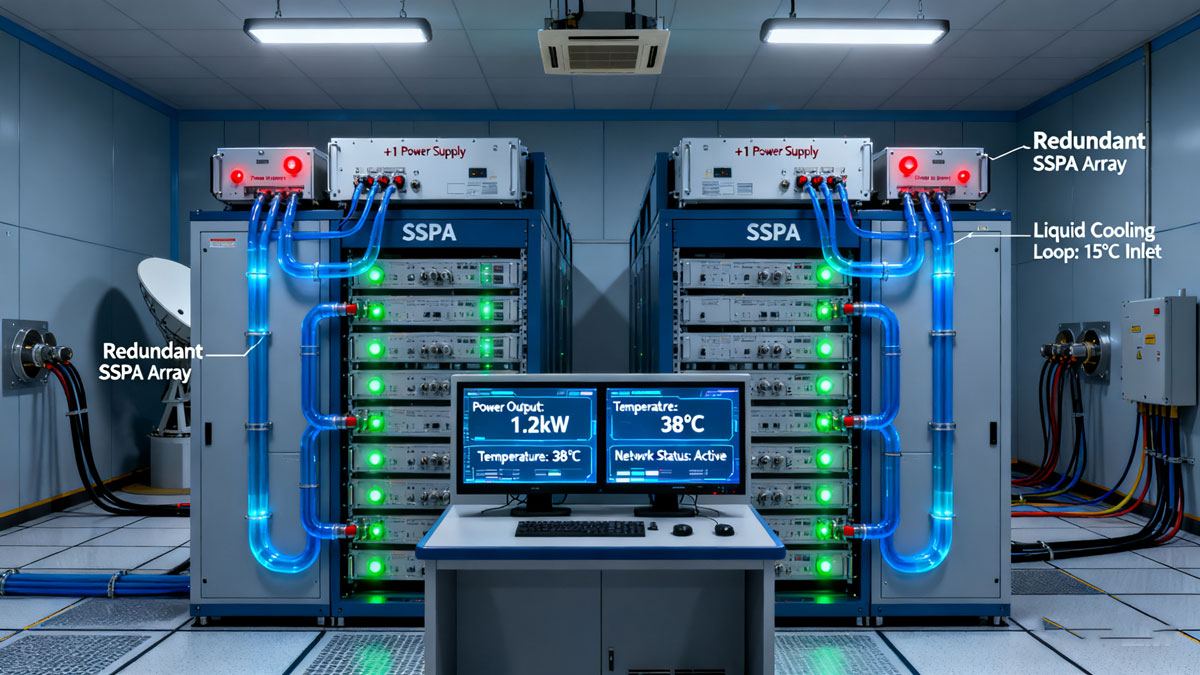
- Redundant power amplifier configurations for critical missions
- Advanced monitoring and remote management capabilities
High-Power VSAT and Teleport (50-400W):
- Broadcast contribution and internet backbone connectivity
- Liquid-cooled systems for maximum power density
- Multi-carrier operation with high linearity requirements
Key VSAT Power Amplifier Selection Criteria:
- Output Power Stability: Maintaining consistent power levels across temperature variations
- Spectral Regrowth Control: Meeting adjacent channel power ratio (ACPR) requirements
- Remote Management: SNMP or web-based interface for network operations
- Environmental Specifications: Operating temperature range matching deployment environment
Space Qualified SSPA: Engineering for the Ultimate Environment
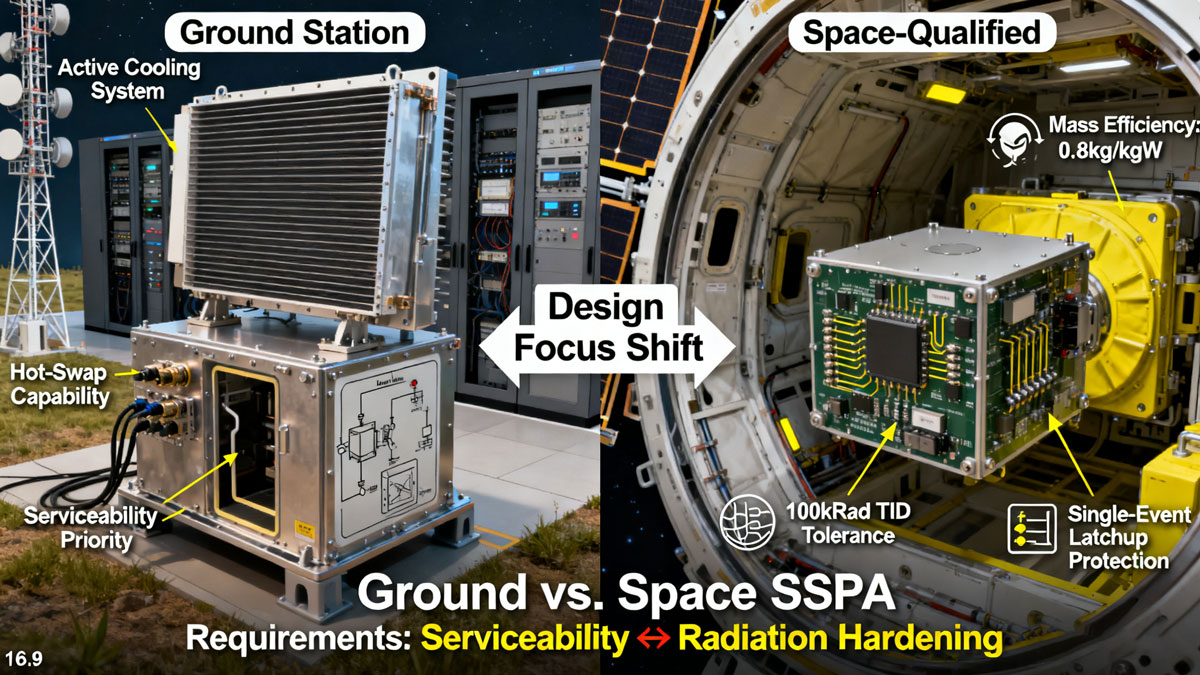
Designing space qualified SSPA requires addressing challenges that simply don't exist in terrestrial applications, where repair or replacement is impossible.
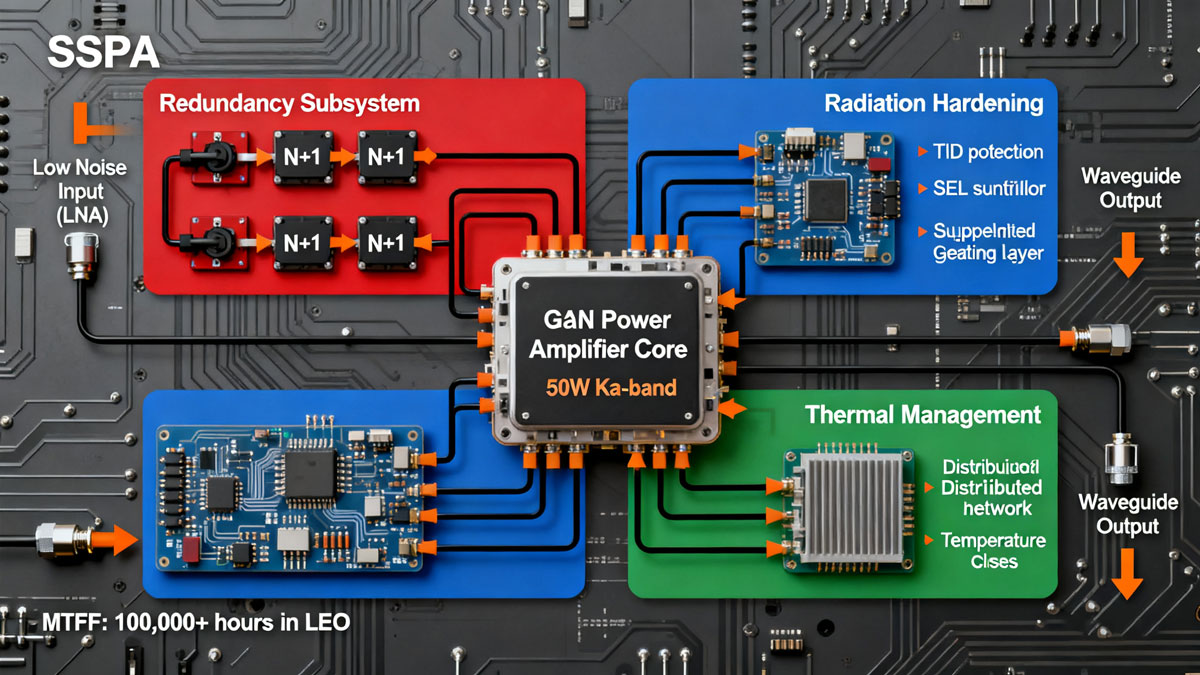
Radiation Effects and Mitigation:
- Total Ionizing Dose (TID): Selection of radiation-hardened components and design margins
- Single Event Effects (SEE): Error detection and correction circuitry
- Displacement Damage: Careful semiconductor technology selection and screening
Thermal Management in Vacuum:
- Conduction-Only Cooling: No convection available in space environment
- Strategic Surface Finishing: Optimizing emissivity for radiative cooling
- Thermal Interface Materials: Ensuring efficient heat transfer to satellite structure
Reliability Engineering and Testing Methodologies
The verification process for space qualified SSPA is exponentially more rigorous than for terrestrial equipment.
Screening and Qualification Testing:
- Burn-in Testing: Extended operation at elevated temperatures to identify infant mortality failures
- Thermal Cycling: Simulating orbital temperature variations from -40°C to +85°C
- Vibration and Shock Testing: Verifying survival during launch conditions
- Life Testing: Accelerated aging to predict long-term reliability
Ground Station SSPA Reliability Features:
- Redundant Amplifier Configurations: 1:1 or N+1 redundancy for critical sites
- Predictive Maintenance: Monitoring performance parameters to anticipate failures
- Modular Design: Field-replaceable units to minimize repair time
Implementation Best Practices Across Applications
Ground Station Deployment:
- Site Preparation: Proper grounding, power conditioning, and environmental control
- Redundancy Planning: Automatic switchover systems for critical applications
- Monitoring Integration: Connecting to network operations centers for proactive management
Space Segment Integration:
- Interface Control: Precise mechanical, electrical, and thermal interface definition
- EMC/EMI Compliance: Ensuring compatibility with other satellite subsystems
- Launch Readiness: Final verification before integration with launch vehicle
Whether implementing a simple VSAT power amplifier for remote connectivity or specifying a complex space qualified SSPA for a satellite payload, success depends on understanding the unique requirements of each environment and selecting amplification solutions with the appropriate performance, reliability, and verification pedigree.
From rugged VSAT power amplifiers for terrestrial networks to radiation-hardened space qualified SSPA for orbital missions, Xiamen Lineyi delivers proven satellite communication solutions. [schedule a consultation] with our space systems specialists.










 Long by picture save/share
