

Application-Based Selection: Where GaN and GaAs SSPAs Excel
Author:Xiamen Lineyi Electronics Co.,Ltd.
Click:
Time:2025-11-08 23:48:47
While understanding the technical differences between GaN and GaAs is crucial, the ultimate decision must be driven by application requirements. Each technology has found its sweet spot in different segments of the RF and microwave industry, with some overlap where system architects must weigh trade-offs carefully.
This application-focused analysis examines where each semiconductor technology delivers the best performance-to-cost ratio across major market segments.
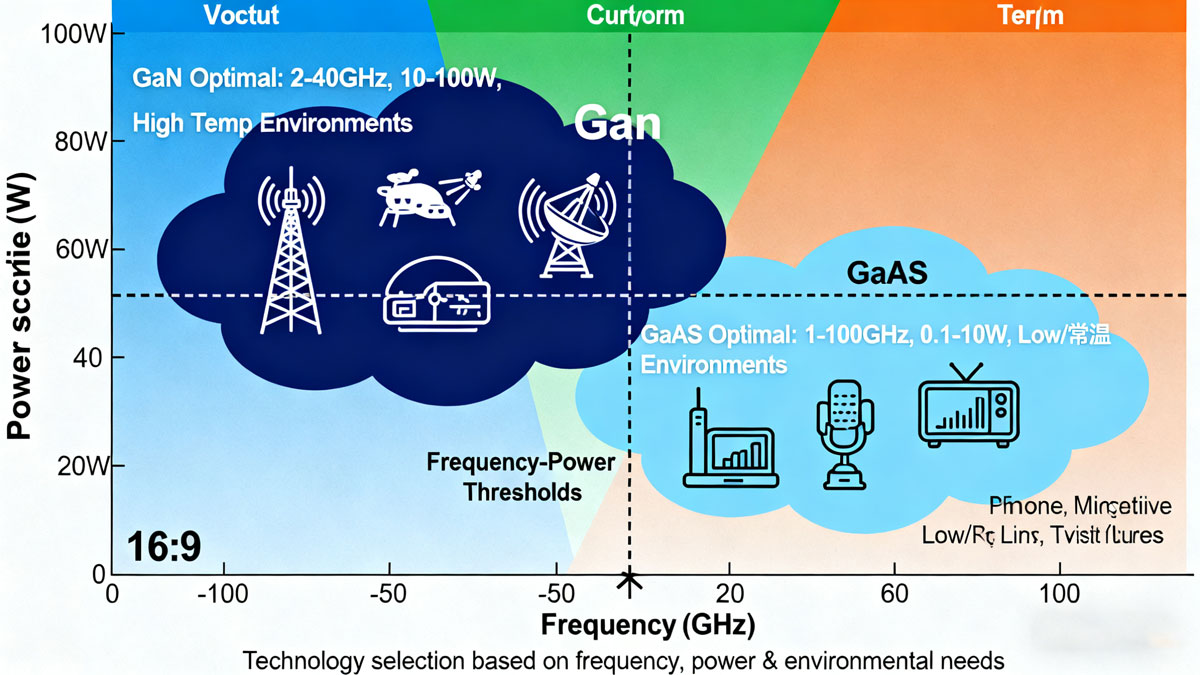
Radar Systems: The Battlefield of Technologies
Modern radar systems represent one of the most demanding applications for SSPA technology, with requirements spanning frequency, power, reliability, and efficiency.
GaN Dominates in:
- Phased Array Radars: AESA (Active Electronically Scanned Array) systems for military and air traffic control benefit tremendously from GaN's high power density and efficiency. A typical array might contain thousands of transmit/receive modules, where GaN's smaller size and lower power consumption provide system-level advantages.
- Weather Radar: High-power weather surveillance systems require robust amplification at S-band and C-band frequencies, where GaN's power handling capabilities excel.
- Naval and Ground Radar: Systems requiring long range and high resolution benefit from GaN's ability to generate high peak powers in compact form factors.
GaAs Remains Relevant in:
- Seeker Heads and Missile Guidance: Where very high frequencies (W-band and above) are required in compact packages, GaAs still offers advantages.
- Secondary Radar Systems: In applications where lower cost and moderate performance are acceptable, GaAs provides a cost-effective solution.
5G Infrastructure: The Efficiency Imperative
The massive deployment scale of 5G networks places unprecedented emphasis on efficiency, power density, and total cost of ownership.
GaN is the Clear Leader in:
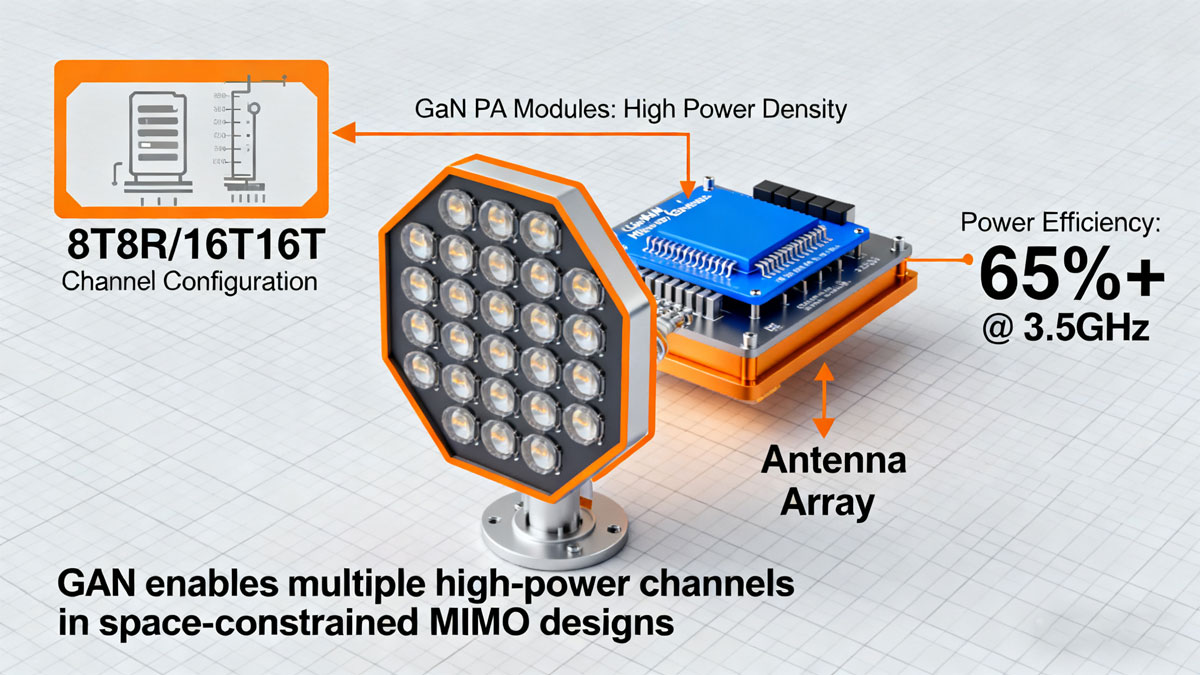
- Massive MIMO Active Antennas: The 64T64R and 32T32R arrays used in 5G base stations demand compact, efficient power amplification. GaN's power density enables integration of multiple high frequency amplifier channels within strict space constraints.
- Macro Cell Power Amplifiers: For both sub-6 GHz and mmWave applications, GaN provides the necessary combination of bandwidth, efficiency, and linearity required for 5G's complex waveforms.
- Small Cell Backhaul: Point-to-point microwave links connecting small cells benefit from GaN's efficiency and reliability.
Satellite Communications: Reliability Above All
The satellite industry values reliability, radiation tolerance, and proven performance in harsh environments.
GaN Applications:
- Earth Station Transmitters: High-power ground station amplifiers for both commercial and military satellite communications increasingly use GaN for its efficiency and reliability.
- L-band and S-band Satellite Terminals: Mobile satellite services and VSAT terminals benefit from GaN's power density and efficiency.
- New Space Payloads: Many new satellite constellations are adopting GaN technology for transmitter payloads, leveraging its radiation tolerance and efficiency.
GaAs Applications:
- Traditional Space-Qualified Payloads: Many existing satellite systems continue to use flight-proven GaAs technology, particularly in higher frequency bands (Ku, Ka, Q/V-band).
- Low Earth Orbit (LEO) Communication Payloads: Where a balance of performance, cost, and heritage is required, GaAs remains competitive.
Electronic Warfare and Defense Electronics
The defense sector demands the ultimate in performance, ruggedness, and reliability across diverse applications.
GaN Dominates in:
- Jamming Systems: High-power jammers for radar and communication denial benefit from GaN's high power density and bandwidth capabilities.
- Military Communications: Tactical radio systems and satellite terminals increasingly specify GaN for its efficiency and ruggedness.
- Electronic Protection Systems: Systems requiring rapid frequency agility and high instantaneous bandwidth leverage GaN's capabilities.
GaAs in Defense:
- EW Receiver Front Ends: Where low noise figure is critical, GaAs low-noise amplifiers (LNAs) still dominate.
- Specialized Millimeter-wave Systems: Certain defense applications above 40 GHz continue to use GaAs technology.
Making the Right Choice: A Decision Framework
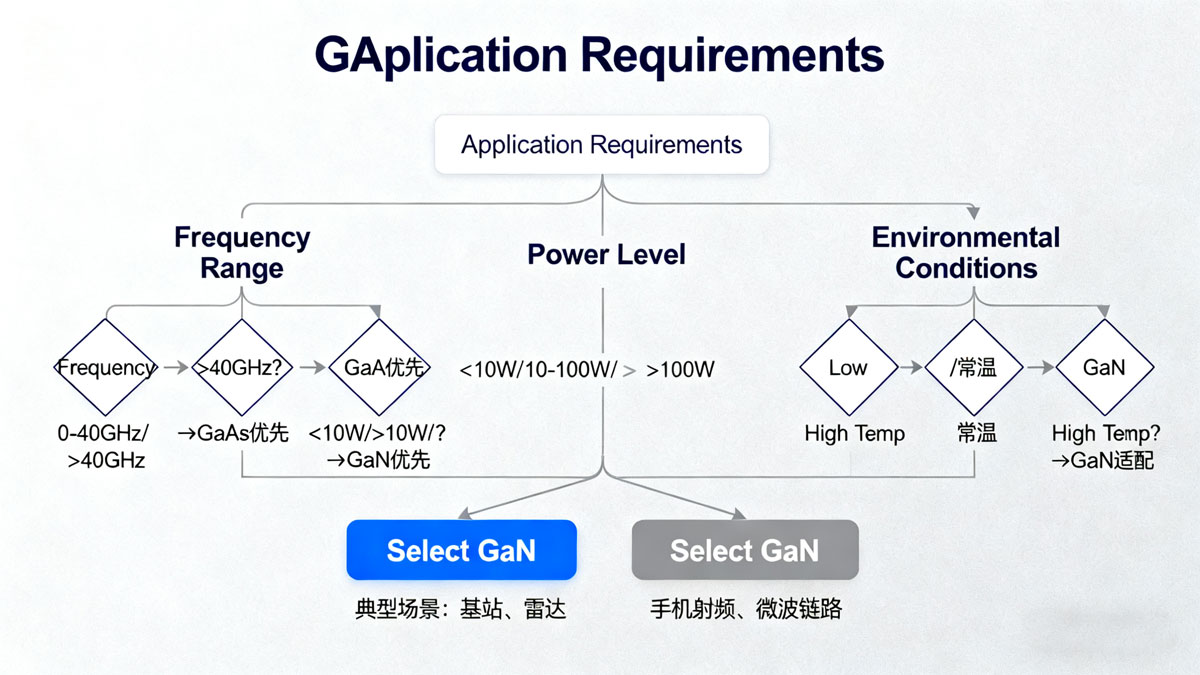
When selecting between GaN and GaAs for your microwave power module, consider these key questions:
- What is your primary frequency range? (GaN:<100 gaas:='' especially='' strong=''>40 GHz)
- What power density is required? (GaN offers 5x advantage)
- What are the efficiency requirements? (GaN typically 5-15% higher PAE)
- What are the environmental constraints? (GaN superior for high temperature, rugged environments)
- What is the total cost of ownership target? (Consider acquisition cost + operating costs)
The choice between GaN and GaAs SSPA technology ultimately depends on your specific application requirements, performance targets, and budget constraints. As both technologies continue to evolve, the boundaries between their optimal application spaces will continue to shift, offering system designers ever-improving options for their most challenging requirements.
Still unsure whether GaN or GaAs SSPA technology is right for your application? Our technical specialists at Xiamen Lineyi can analyze your specific requirements and recommend the optimal solution. [Request a free application analysis] from our engineering team today.

点击右上角
分享给朋友吧







 Long by picture save/share
0
Copyright © Xiamen Lineyi Electronics Co., Ltd All rights reserved.
点击右上角
分享给朋友吧
