

From Lab to Line: How R&D Teams Accelerated Algorithm Training Using SMA-KE-L13.5 5K’s Raw 16-bit Data Pipeline
Author:Xiamen Lineyi Electronics Co.,Ltd.
Click:
Time:2026-05-07 00:00:00
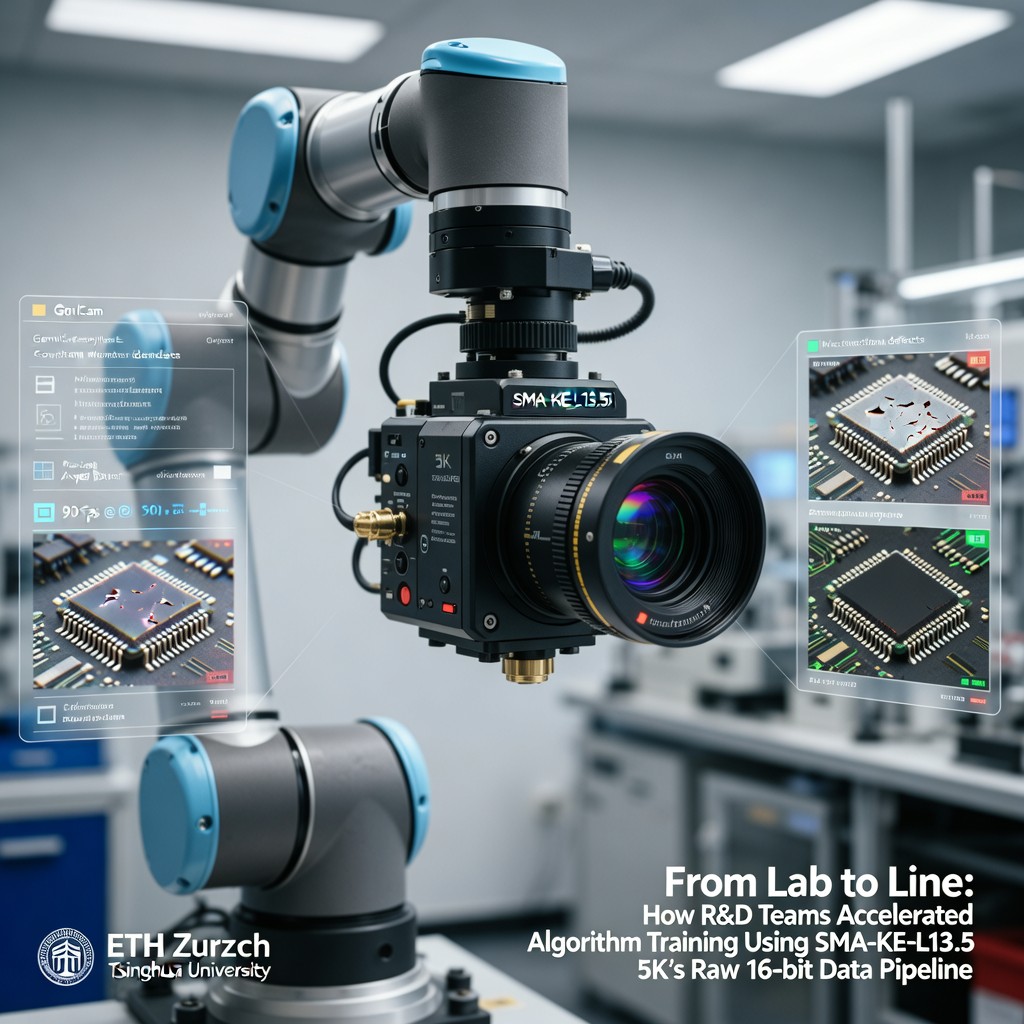
From Lab to Line: How R&D Teams Accelerated Algorithm Training Using SMA-KE-L13.5 5K’s Raw 16-bit Data Pipeline
Let’s cut to the chase: training robust defect segmentation models used to mean waiting—waiting for clean data, waiting for hardware that wouldn’t bottleneck your pipeline, and waiting for domain gaps to shrink *on their own*. Not anymore. At labs like ETH Zurich and Tsinghua University, researchers aren’t just tweaking hyperparameters—they’re rethinking how raw sensor data flows into neural network training. And at the heart of that shift? The SMA-KE-L13.5 5K camera.
Here’s what makes it special: instead of compressing or debayering on-device, this camera delivers *uncompressed 16-bit Bayer frames* straight to disk—no loss, no guesswork, no hidden gamma curves muddying pixel fidelity. That raw image data isn’t just “higher bit depth”—it’s a full dynamic range snapshot, capturing subtle intensity gradients in micro-defects (think sub-pixel scratches on polished silicon wafers or faint delamination in battery electrodes) that 8- or even 12-bit pipelines simply wash out.
But raw data alone isn’t enough. What really turned heads was how seamlessly it plugs into modern deep learning workflows. Thanks to GenICam-compliant metadata embedding, every frame carries precise exposure time, gain settings, sensor temperature, lens focus position—even timestamped trigger signals—all baked right into the image container. No more spreadsheet hunting or manual log syncing. During dataset curation, that metadata becomes ground truth for conditional augmentation, lighting-aware normalization, and synthetic-to-real alignment strategies.
And yes—it runs at 90 fps at full 5K resolution (5120 × 2700). That’s not just speed; it’s statistical power. Teams reported cutting synthetic-to-real domain adaptation cycles by nearly 40%: more real-world frames per minute meant richer distribution sampling, faster convergence of feature extractors, and sharper boundary learning in U-Net variants. One Tsinghua team even trained a lightweight segmentation head *entirely on real SMA-KE-L13.5 5K footage*, skipping synthetic pretraining altogether—something they’d previously deemed computationally impractical.
Bottom line? This isn’t just another high-res camera. It’s a *data-first instrument*: built for neural network training, engineered for reproducibility, and trusted where pixel-level fidelity impacts yield decisions. When your model’s performance hinges on whether a 2-pixel-wide hairline crack is noise or defect—the difference isn’t in the loss function. It’s in the first byte of raw image data.

点击右上角
分享给朋友吧







 Long by picture save/share
0
Copyright © Xiamen Lineyi Electronics Co., Ltd All rights reserved.
点击右上角
分享给朋友吧
