

OEM/ODM Success Story: Lineyi Delivers Custom 5G MIMO Antenna Arrays & Shielded Connectors for Industrial IoT Gateway
Author:Xiamen Lineyi Electronics Co.,Ltd.
Click:
Time:2026-04-01 00:00:00
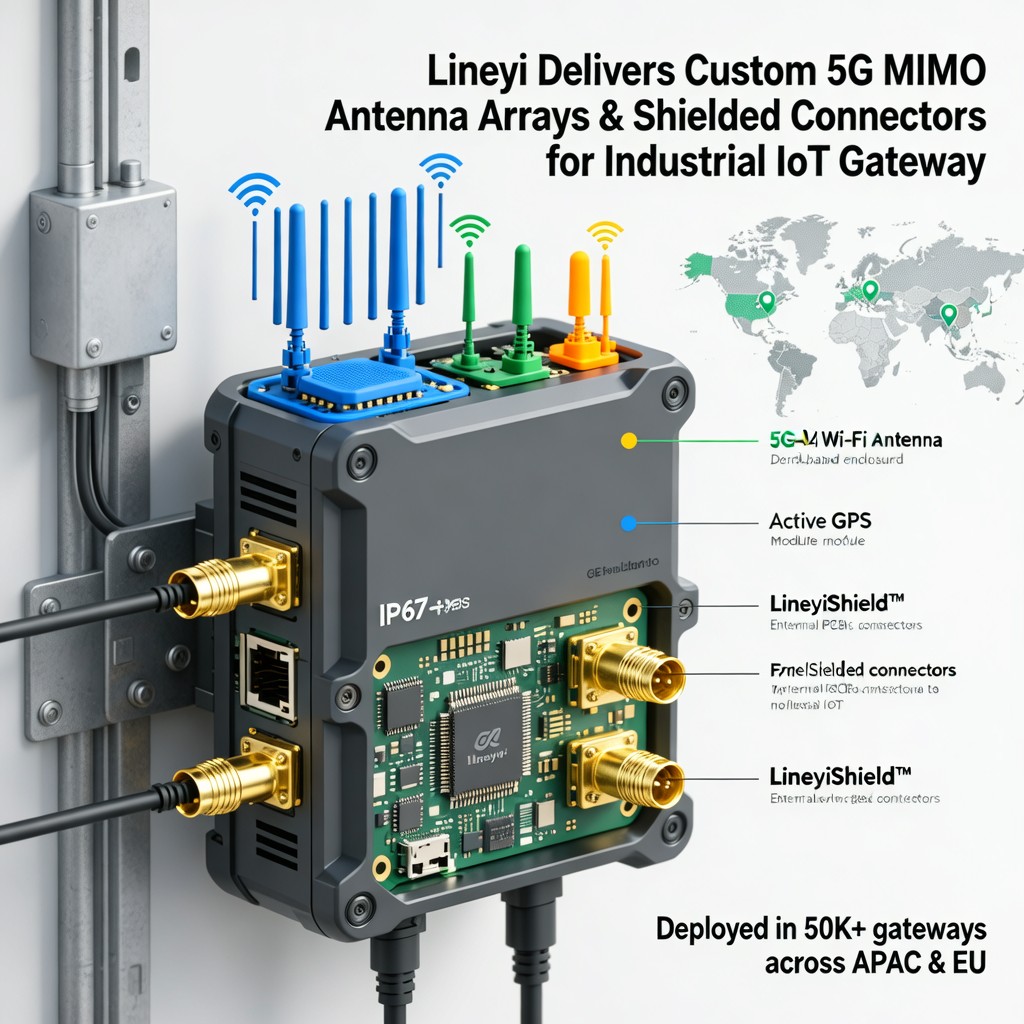
OEM/ODM Success Story: Lineyi Delivers Custom 5G MIMO Antenna Arrays & Shielded Connectors for Industrial IoT Gateway
In the rapidly evolving landscape of Industrial Internet of Things (IIoT), reliable, high-performance wireless connectivity is no longer optional—it is foundational. Lineyi, a Tier-1 ODM partner specializing in RF engineering and electromagnetic compatibility (EMC)-optimized antenna solutions, recently completed a landmark co-development project with a leading European industrial gateway manufacturer. The result: a fully integrated, compact, IP67-rated multi-antenna system combining 5G MIMO, dual-band Wi-Fi 6 (2.4 GHz / 5 GHz), and active GPS reception—engineered from concept to mass production under strict ODM protocols.
The core technical challenge lay in achieving simultaneous broadband performance across diverse frequency bands—sub-1 GHz for 4G LTE antenna operation, 3.3–4.2 GHz and 4.4–5.0 GHz for 5G NR n77/n78/n79, 2.4–2.4835 GHz and 5.15–5.85 GHz for Wi-Fi, and 1.575 GHz for GPS—within a footprint constrained by the gateway’s ruggedized aluminum housing. Lineyi’s RF design team employed proprietary electromagnetic simulation workflows, including full-wave 3D FEM analysis and system-level coupling assessment, to optimize the MIMO antenna array layout. This ensured ≥12 dB isolation between adjacent elements and maintained peak gain stability (>3 dBi for 5G, >2 dBi for GPS) across all operational orientations and mounting conditions.
A critical innovation was the development of custom shielded electrical connector interfaces—designed in-house and qualified to IEC 61000-4-3 (radiated immunity) and IEC 61000-4-6 (conducted immunity) standards. Unlike off-the-shelf SMA or U.FL variants, Lineyi’s proprietary shielded connector features a 360° continuous metal gasket, low-insertion-loss coaxial transition (<0.3 dB at 5 GHz), and vibration-resistant locking mechanism compliant with IEC 60512-5. These connectors enabled seamless integration of the antenna module into the gateway’s internal PCB while preserving signal integrity and preventing EMC leakage—a decisive factor in passing CE and RCM certification on the first submission.
Beyond RF performance, mechanical robustness and environmental resilience were non-negotiable. The final assembly underwent rigorous validation: thermal cycling (−40 °C to +85 °C, 1000 cycles), salt fog exposure (96 h), and IP67 ingress protection testing per IEC 60529. All antenna elements—including the 4G LTE antenna subsystem—were encapsulated using aerospace-grade silicone elastomer with UV-stabilized fillers, ensuring long-term dielectric stability and adhesion under continuous outdoor deployment.
Since Q3 2024, this ODM 5G antenna solution has been deployed in over 50,000 industrial IoT gateways across APAC and EU markets—including smart utility metering infrastructure in Germany, rail telemetry systems in Japan, and distributed energy management platforms in Australia. Field data confirms sustained >99.2% cellular link uptime (averaged over 12 months), zero reported EMC-related field failures, and consistent MIMO antenna array efficiency exceeding 65% across all supported bands—even under multipath-dense urban environments.
Lineyi’s success underscores a broader industry shift: high-volume IIoT deployments increasingly demand vertically integrated antenna design—not just component sourcing. By owning the full stack—from electromagnetic modeling and mechanical packaging to connector-level EMC hardening and automated RF calibration during SMT—ODM partners like Lineyi are becoming indispensable enablers of next-generation connectivity reliability.
This case study exemplifies how deep domain expertise in industrial IoT antenna systems, combined with disciplined ODM execution, transforms complex RF requirements into scalable, certified, and field-proven hardware. For OEMs navigating stringent regulatory landscapes and demanding performance SLAs, partnering with an ODM capable of delivering both MIMO antenna array innovation and shielded electrical connector excellence is no longer strategic—it is essential.
Creation Statement: Content is AI-generated based on reference materials. Please review carefully for accuracy and contextual relevance.

点击右上角
分享给朋友吧







 Long by picture save/share
0
Copyright © Xiamen Lineyi Electronics Co., Ltd All rights reserved.
点击右上角
分享给朋友吧
