

Decoding "5G WiFi": The Technical Evolution to WiFi 6 & 6E
Author:Xiamen Lineyi Electronics Co.,Ltd.
Click:
Time:2026-01-17 14:32:13
In the landscape of modern connectivity, few terms cause as much confusion as '5G WiFi.' Consumers and IT managers alike are left wondering: What is a 5G WiFi network in technical terms, and how does it relate to the cellular 5G advertised for smartphones? The truth is, '5G WiFi' is an informal and often misleading label for a significant leap in wireless local area networking (WLAN) technology, formally standardized as IEEE 802.11ax or, more simply, WiFi 6. Its advanced extension is known as WiFi 6E. Understanding this distinction is not just about semantics; it's about comprehending a major upgrade designed to solve the congestion and performance challenges of our device-saturated world.
This article moves beyond the marketing to explore the rigorous wifi 6 standard, its key technological pillars, and why this evolution—sometimes colloquially called 5G wifi—represents a fundamental redesign for efficiency, not just a speed bump.
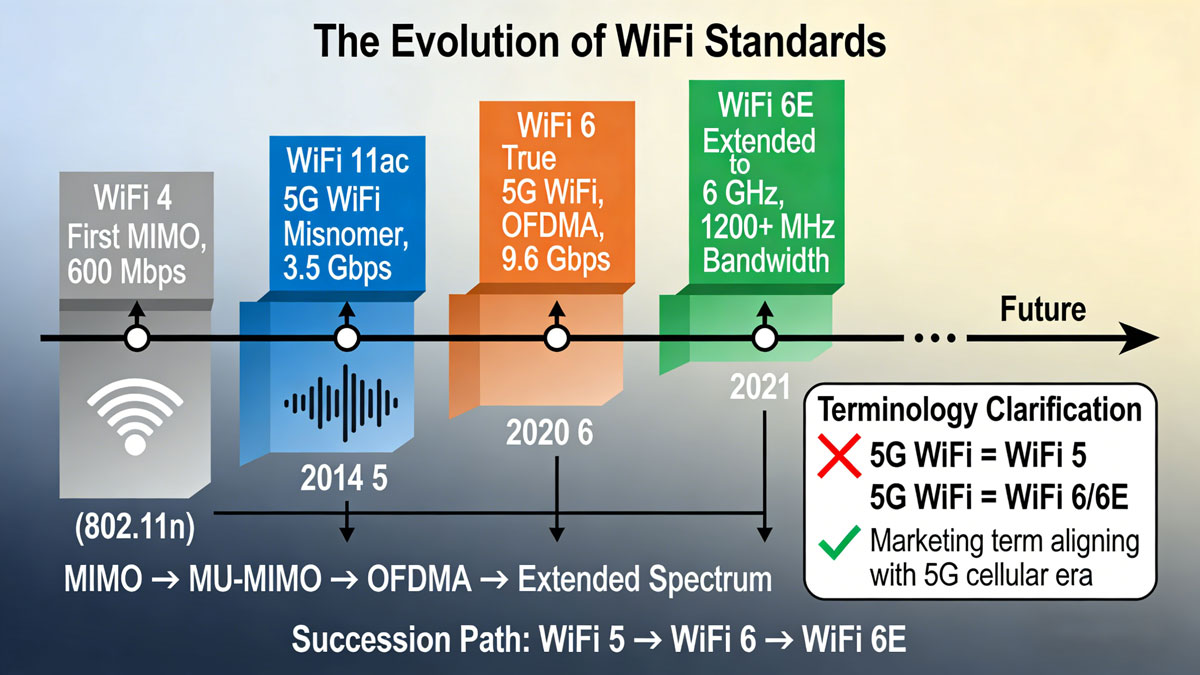 The evolution of WiFi standards. The so-called '5G WiFi' corresponds to the latest generations: WiFi 6 and WiFi 6E, a direct successor to WiFi 5 (802.11ac).
The Core of WiFi 6: A Symphony of Efficiency Technologies
The wifi 6 standard was engineered with one primary goal: to manage multiple devices communicating simultaneously in dense environments—think smart homes with 30+ devices or open-plan offices. The benefits of wifi 6 stem from these core technologies:
- OFDMA (Orthogonal Frequency-Division Multiple Access): This is the cornerstone advancement. Traditional WiFi sends data in large 'packets' to one device at a time, even if the packet isn't full—like sending a semi-truck to deliver a single envelope. OFDMA divides the wireless channel into smaller sub-carriers, allowing a single transmission to carry data for multiple devices simultaneously. It effectively packs the truck with envelopes for different addresses, drastically improving network efficiency and reducing latency for all connected devices.
- Uplink & Downlink MU-MIMO: While previous generations introduced Multi-User MIMO for downloads, WiFi 6 extends it fully to uplink traffic. This allows an access point to receive data from multiple devices at the same time. In practice, this means smoother video conferencing where your upload is as robust as your download, and smarter homes where many sensors can report back concurrently without waiting for their turn.
- 1024-QAM (Quadrature Amplitude Modulation): This increases the data density of the signal. By encoding more bits per transmission symbol, 1024-QAM boosts peak data rates by about 25% over the 256-QAM used in WiFi 5, pushing theoretical maximum speeds closer to 9.6 Gbps under ideal conditions.
- BSS Coloring (Basic Service Set Coloring): This feature tackles interference from neighboring networks. It 'tags' data frames from your network with a color. Your devices can then ignore 'different colored' signals from the apartment next door, treating them as background noise rather than waiting for that channel to clear. This significantly improves performance in congested multi-dwelling units or office parks.
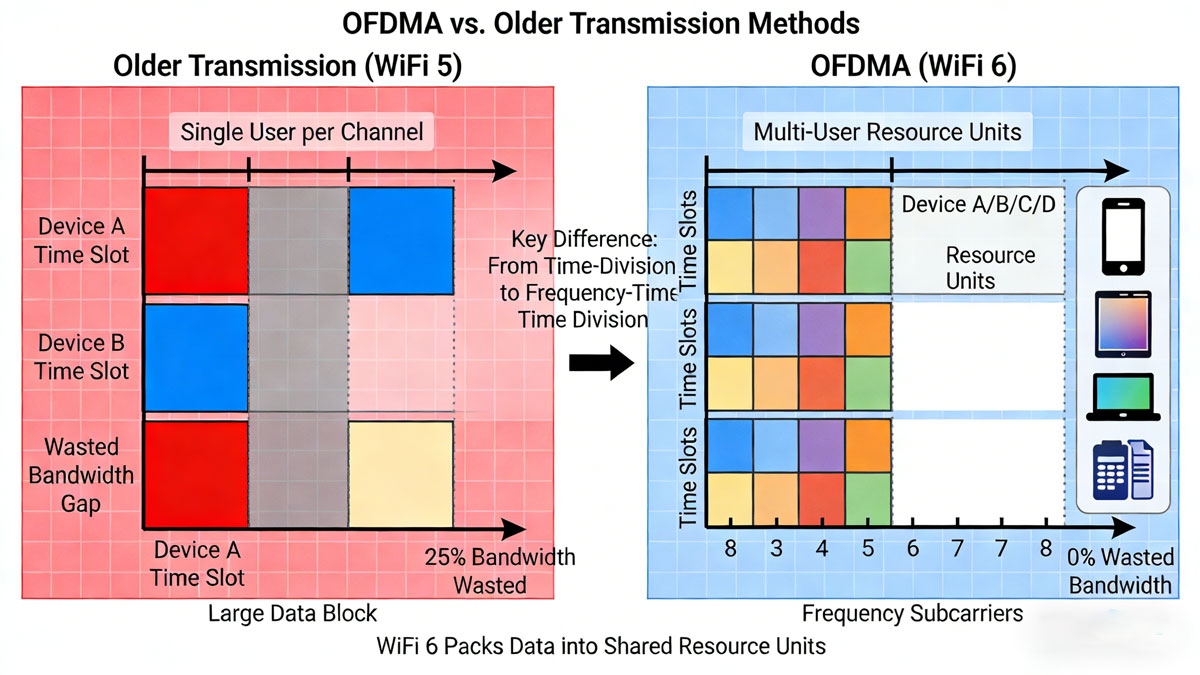 A conceptual diagram of OFDMA versus older transmission methods. It visualizes how WiFi 6 packs data for multiple users into shared resource units, eliminating wasted bandwidth.
WiFi 6E: The Game-Changing Expansion into 6 GHz
If WiFi 6 is a smarter traffic control system, WiFi 6E provides entirely new, wide-open highways. The 'E' stands for 'Extended,' referring to the opening of the 6 GHz frequency band (5925-7125 MHz) for unlicensed WiFi use.
- Unprecedented Spectrum: This adds up to 1,200 MHz of new bandwidth, which is more than the total usable spectrum in the 2.4 and 5 GHz bands combined. This means access to up to seven additional 160 MHz-wide channels.
- The End of Congestion (For Now): Since the 6 GHz band is new, it is free from legacy devices (WiFi 4, WiFi 5) and common interference sources like Bluetooth and microwave ovens. This results in consistently clean, high-performance connections ideal for latency-sensitive applications.
- True High-Bandwidth Potential: The wide, contiguous channels in the 6 GHz band are perfect for unlocking the full multi-gigabit potential of WiFi 6, supporting 8K video streaming, massive file transfers, and immersive VR/AR experiences without compromise.
Clarifying the Confusion: '5G WiFi' vs. Cellular 5G
So, why the confusing name? The '5G' in some router settings historically referred to the 5 GHz radio band, not a generation. When cellular technology launched its '5th Generation' (5G), the colloquial router term '5G wifi' unfortunately collided with the mobile industry's branding. It's crucial to understand that WiFi 6 is a local network standard you control in a finite space, while cellular 5G is a wide-area mobile service provided by a carrier. They are complementary technologies; your phone uses WiFi 6 at home and 5G on the go. The real-world benefits of wifi 6 are most apparent in these controlled, high-density local environments.
Building devices for the next generation of local connectivity? Ensure they leverage the full potential of the wifi 6 standard. Xiamen Lineyi specializes in designing high-performance antennas optimized for WiFi 6 and 6E frequencies, ensuring superior range and reliability for your products. [Contact our engineering team] to discuss your antenna requirements.

点击右上角
分享给朋友吧







 Long by picture save/share
0
Copyright © Xiamen Lineyi Electronics Co., Ltd All rights reserved.
点击右上角
分享给朋友吧
